Rule descriptions are checked against the official How to Play page and the official Scoring page. Strategy advice is our interpretation. The 120 practice prompts are invented examples and are clearly separated from live game screenshots and official board facts.
The game in one clear picture
Noillirk asks you to supply an answer that fits a category. The challenge is to choose the answer most people would probably give, rather than the rarest correct answer you can remember. A prepared board estimates how a crowd of one hundred would answer each prompt. The more prominent your answer is on that board, the higher its scoring band. This changes the usual trivia instinct. Knowledge still helps you recognize valid answers, but judgment about familiarity is what separates a modest result from a high one.
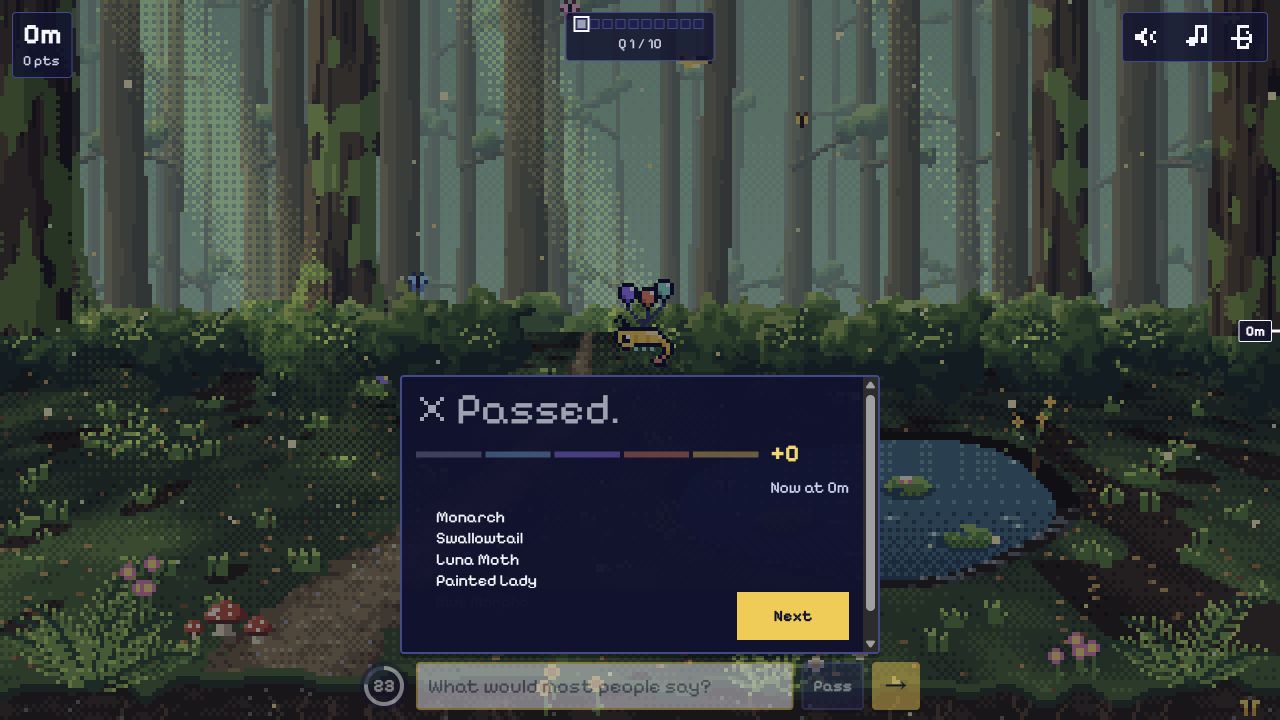
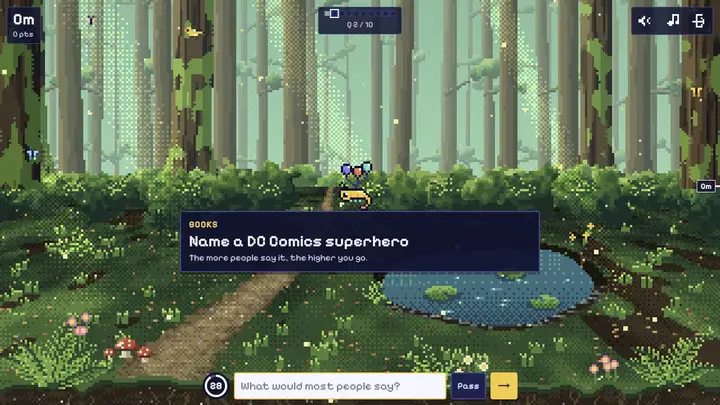
A Daily contains ten prompts, and each prompt gives you thirty seconds. Type an answer and submit it. Your first accepted answer ends that round; you cannot replace it with a more popular one after seeing the result. If the game does not recognize an answer, the clock continues and you can try again while time remains. You can also pass. A pass or timeout earns zero for that prompt, but does not deduct earlier points. The Daily is available once per local day and progress is saved in that browser.
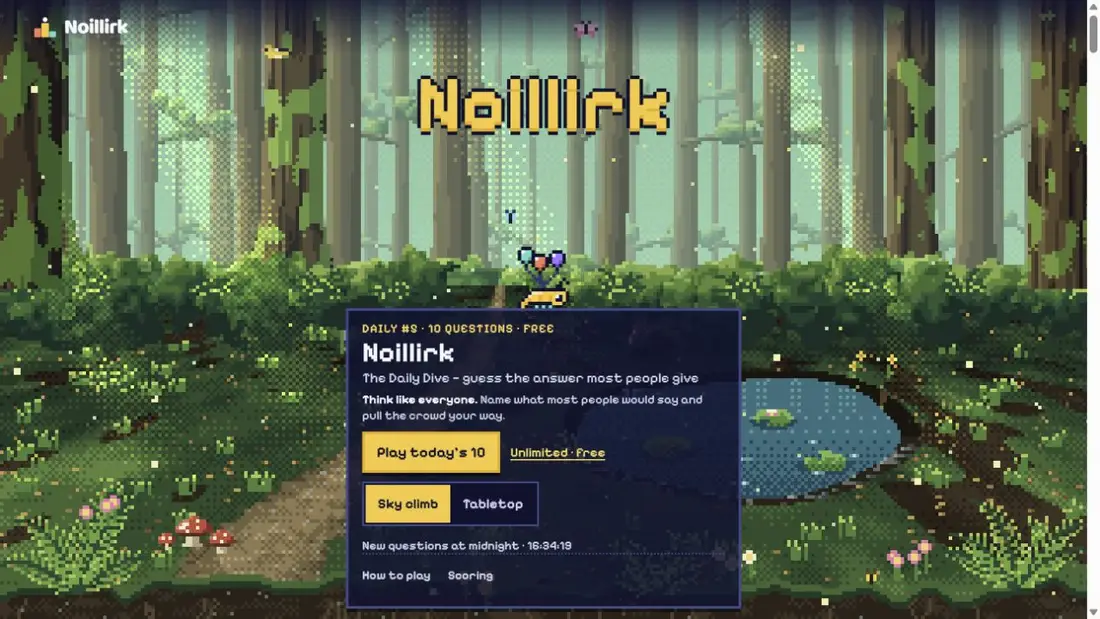
The game currently offers two visual stages. Sky Climb is the default in the official rules: a small krill rises through pixel-art scenery as your points accumulate. Tabletop represents the same scoring through a crowd of one hundred people and a set of answer tiles. Stage choice changes presentation, not the answer bands or point formula. This guide uses genuine Sky Climb screenshots from one live Daily; question wording and imagery may change in future runs.
This independent guide is designed for reading before a first run, checking a rule after an unexpected result, and practicing the special kind of judgment the game rewards. It does not contain a list of today's answers. Such a list would age immediately, remove the central challenge, and imply certainty that a practice exercise cannot provide. Instead, the later workbook asks you to compare a familiar candidate with a more specific one, state why you favor it, and notice where your own knowledge might mislead you.
Your first Daily, step by step
Start on the official game or use the embedded game on our home page. Choose the Daily, confirm the stage you want, and begin the first prompt. Look at the whole category before deciding. Words such as “a”, “a type of”, “in Europe”, “by a singer”, or “from a series” set the boundaries. A response that is famous but outside those boundaries may not be accepted. Keep one candidate in mind while checking the category, then enter it with enough time left to recover if the game rejects it.
The submitted answer is the main decision of a round. A common, ordinary response can outperform a more surprising example. The score is tied to a fixed estimated board, not a live poll of the people who happen to play today. After a round, read the band and the top-five board. If your answer was accepted but low, the reveal tells you what kind of mental shortcut the board favored. If you missed the clock, use the board to rehearse a quicker answer next time; there is no penalty beyond the zero for that prompt.
On Sky Climb, the result waits for you to press Next or Enter. On Tabletop, the animation normally moves on by itself, and you can tap the table or the skip control to move faster. Ten prompts make a short session, but it is worth pausing between them. The multiplier changes later in the run, so your late answers carry more weight. A calm first five questions can preserve attention for the high-value final pair.
When the run ends, check the total points, number of #1 answers, and the answer review. On Tabletop, the people who joined your home tile offer another summary of the run. A title describes the pattern of your bands, not a separate set of bonus points. The answer review is the most useful learning screen: compare the first candidate you actually typed with the top five the game revealed. Write down the category, the candidate, and the reason for the mismatch if you want to improve over several days.

What the clock and answer field really do
The thirty-second limit makes this a decision game as much as a recall game. The best procedure is short: identify the requested class, name one familiar example, verify that it fits, and submit. You can use a more detailed search of memory only if your first thought is clearly outside the category. Waiting for the mathematically perfect response is risky because a valid answer is worth at least something while an expired clock is worth nothing.
The official rules say the timer pauses when you switch to another browser tab. That behavior helps with interruptions, but it does not make the round an open-book research test. The intended judgment is still what a typical person would name. If you look up a long list, the unusual answers on that list can crowd out the familiar one you already knew. Treat the pause as a convenience, and make your actual answer from the wording in front of you.
Case, accents, punctuation, and a leading article are generally normalized. Plurals may be treated as singular; common alternate names and small spelling slips in answers of at least five characters can be recognized. The official rules give one tolerated character error in a longer answer, while shorter names need exact spelling. These allowances make typing less fragile, but they do not guarantee that every plausible synonym or obscure example is on the prepared acceptance list.
If an answer is refused, the round stays open and the timer continues. Do not spend the remaining seconds arguing with the field. Replace the entry with a simpler, more familiar example that you know fits. If you end the round with a pass or timeout after a rejected answer, the game may offer a “Should this count?” report. That is a useful feedback route for a truly valid missing answer. It does not retroactively score the round, so the practical move under time pressure is still to try another candidate.
Read the five scoring bands
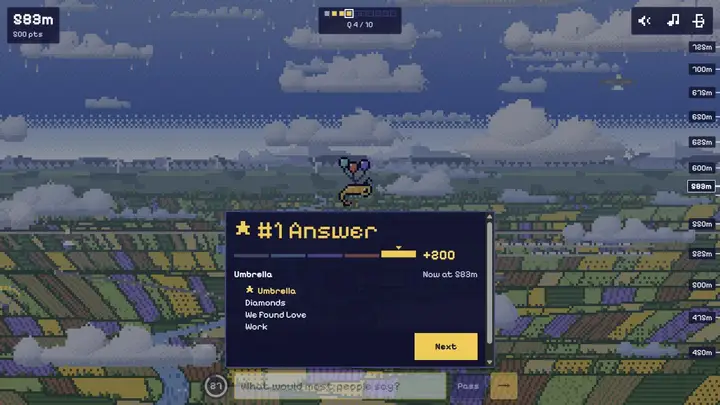
Every accepted answer belongs to one of five bands. Off the Board means accepted but outside the ranked ten and earns 10 base points. Top 10 means places six through ten and earns 25. Top 5 means fourth or fifth and earns 50. Runner-up means second or third and earns 75. The #1 Answer earns 100. A clever answer does not gain an extra reward for being difficult; it is judged by the same estimated popularity board as any plain answer.
The band system is easier to remember as a staircase of familiar responses. The top answer receives ten times the base points of an accepted answer outside the board. The middle steps matter too. Moving from Off the Board to Top 10 adds 15 base points; moving from Top 10 to Top 5 adds 25; moving from Top 5 to Runner-up adds 25; and moving from Runner-up to #1 adds another 25. Those differences grow when the later question multiplier is applied.
The board is prepared in advance as an estimate of what one hundred people would say. It is not a live count of today's players, and another player's response does not move your answer up or down while you play. This matters when you interpret a surprising result. You may sincerely believe a response is more famous than the displayed ranking. The game is applying its prepared board; use the reveal as information about that board rather than treating your personal memory as a hidden official ranking.
For a worked illustration in the official scoring page, the category is a European capital. Paris appears as the #1 answer, London as Runner-up, Berlin as Top 5, Amsterdam as Top 10, and Skopje as an accepted answer outside the board. That example explains the mechanic, not the answer to an upcoming Daily. Our practice cases later in this guide are different: they are invented exercises and never assert that a particular word is accepted or ranked on a live Noillirk board.
Multipliers, totals, and the late game
The Daily weights questions one and two at ×1, questions three through five at ×2, questions six through eight at ×3, and questions nine and ten at ×4. Multiply the base value of your band by that question's weight. A Runner-up answer is therefore 75 points early, 150 in the middle, 225 in the next group, and 300 in the final pair. A #1 answer in question ten earns 400, while an Off the Board answer there earns 40.
Ten #1 answers produce the maximum Daily total of 2,500 points: two hundred in the first pair, six hundred across the next three, nine hundred across questions six to eight, and eight hundred in the last two. This ceiling is useful for understanding the scale, not as a reasonable expectation for a new player. A mixed run can still feel strong if it avoids zeros and finds a few prominent answers near the end.
The changing weights suggest a practical attention plan. In the first two prompts, learn the interface and settle into a quick response rhythm. In the middle, notice which sorts of names the board rewards. During questions six through eight, avoid needless delay because an accepted answer is now more valuable. In questions nine and ten, stay with a recognizable example even if an obscure alternative seems more impressive. The multiplier does not make an answer more valid; it increases the cost of a popularity mistake or a timeout.
Unlimited repeats the same pattern for every ten questions according to the official scoring page. Question eleven starts again at ×1, and question seventeen is in a ×3 segment. The mode can be set for ten or twenty prompts or an endless run. Its chief value for learning is repetition without consuming the next Daily. The categories will vary, so focus on the decision method rather than memorizing a particular revealed board.

Sky Climb and Tabletop
Sky Climb turns cumulative points into height. The krill begins in a forest, suspended from three balloons, and rises through new scenery as accepted answers add points. Passing leaves the character where it is; earlier height is not lost. The official guide says a #1 answer in the first question reaches 30 meters, and a perfect Daily of 2,500 points ends at 14.0 kilometers. These are game mappings of score to height, not a separate scoring formula you need to optimize.
Tabletop shows a crowd of one hundred around a prepared board. The top five answers appear on tiles, with more people and space for more prominent answers. Your figurine moves to your answer. If it is outside the top five but accepted, it receives a smaller tile to the side. Each 25 points from that round brings one person to your home tile, rounded down for that individual round. A 10-point early Off the Board answer therefore brings nobody, while a 100-point first-round #1 answer brings four.
The two presentations reward the same choice. A high board position always brings more points; Sky Climb expresses those points as height and Tabletop expresses them as people joining you. If you prefer a calm, direct result panel, the Sky Climb screenshot sequence in this guide may feel familiar. If you learn better by seeing a distribution of answers, Tabletop makes the estimated crowd visible. The stage can be switched from the official start screen, and the browser remembers the choice.
Do not confuse the visual crowd with live votes. The tabletop distribution is the game's prepared estimate. It can be helpful to say aloud, “Which name would a hundred strangers think of first?” That question matches the design of both stages. When your own favorite answer lands outside the top five, the reveal is a cue to adjust your crowd model, not evidence that the answer was factually wrong.

Daily progress, streaks, and review
The Daily gives everyone on the same local date the same ten prompts. New questions arrive at local midnight. The official rules say Daily #1 was October 15, 2026. The number identifies a day's set of prompts; it does not imply that the set stays current forever. A guide that tried to publish today's answers would therefore become stale and could spoil the experience for readers in another timezone.
A partly completed Daily is saved in the same browser. If you exit mid-run, the intro can offer to resume at the next question you had reached. The streak also lives in that browser. Completing Dailies on consecutive days extends it; missing a day causes a later completion to begin a new streak. A different device or private window will not necessarily have that local progress. These are practical reasons to keep one browser for your regular Daily.
After a run, the Answers review lists your response, its band and points, and the board's top five for each prompt. Read this as ten compact lessons. On a prompt where you scored low, ask whether your candidate was too narrow, less widely known, or simply slower to recall than a more obvious alternative. On a high result, ask whether the choice came from a repeatable principle or a lucky guess. Both kinds of review improve the next run.
A useful personal record needs only four columns: category, your first candidate, the submitted answer, and the revealed top answer. Add one sentence about why you changed or kept your first thought. You do not need to copy an entire board or chase a perfect score. Over several sessions, you may notice a personal pattern: perhaps you overvalue specialist knowledge, or perhaps you keep second-guessing a famous name in the final five seconds. That pattern is more useful than any isolated daily total.

Unlimited as a practice room
Unlimited is free and has no daily cap. It offers ten-question, twenty-question, and endless runs. The first ten prompts of a run move from easier to harder according to the official rules. You can end a run early with the close control and still see results so far, but an Unlimited run cannot be resumed later. It does not alter the Daily streak. That makes it a convenient place to test a strategy without turning a Daily into a rehearsal.
Practice with one rule at a time. On one run, commit to the first plainly valid and familiar answer within ten seconds. On another, use the extra seconds to compare two candidates, but make the comparison explicit: which would more strangers mention first? Afterward, review where the slower method actually helped. If the second candidate frequently scores lower, you have learned that deliberation is pulling you toward rare knowledge rather than better crowd prediction.
A long endless run can become mentally noisy. Reset your attention every ten questions, because the multiplier pattern restarts then. If you are practicing speed, keep the session short enough that you still read the categories carefully. A rushed response to the wrong class is worse than a calm response submitted with twenty seconds left. The goal of training is a stable decision procedure, not a reflex to type the first related word.
You can also use the hypothetical drills below without playing. Cover the two candidate examples, read the category, and name a crowd anchor aloud. Then reveal the discussion and compare your reasoning. These exercises are not official question data or predicted board results. Their purpose is to make the tradeoff between familiar and specialized examples visible before a real timer starts.

Challenges, sharing, and comparison
A finished Daily can provide share text and a challenge link. The text shows a compact pattern of colored result dots, a title, and the number of people pulled, without disclosing every answer. A friend who follows a challenge link plays the same prompts in the same order. After each answer they can see the challenger's pick on the table, and the end compares the runs. The comparison is based on people pulled, with points used to break ties on the challenge board.
The Daily's player percentile is a separate comparison. It concerns finished runs of that same Daily that reached the game's service. A statement such as “better than 72%” means that proportion pulled fewer people than you. It does not mean your personal answer was more popular than 72% of people in a particular prompt. Early in the day the comparison may show a first-finisher or first-ten message, and very low percentages may be hidden.
Sharing is more enjoyable when it preserves the puzzle. Send the built-in card or link rather than posting a list of the day's top five answers. If you want to discuss strategy, talk about category interpretation or the moment you changed your mind without disclosing a current prompt to someone who has not played. A challenge is most informative when both players confront the same uncertain choices independently.
A close challenge result can reflect several small differences rather than one spectacular answer. The late ×4 pair contributes a great deal, but avoiding an early timeout can also matter. Look at the answer review after a comparison and identify one decision you would repeat, one you would shorten, and one where you should have trusted the ordinary response. That keeps the competition connected to a learnable method.
A practical method for crowd guesses
Begin with category fit. An answer can be famous and still fail because the prompt asks for a narrower kind of object, a specific creator, a geographical boundary, or a particular medium. Parse the noun first and the qualifier second. For “a song by an artist,” name a song, not the artist or an album. For “a capital in a region,” check that the city is a capital and belongs to the region. This small grammar check prevents avoidable rejections.
Next, favor broad recognition. Imagine a mixed group of strangers who have not read your favorite niche source. Which example will they retrieve quickly? A household name may beat a technically elegant or historically important answer because the game measures estimated common recall. This does not guarantee a #1 answer. People vary by age, place, and culture, and the game's prepared board may differ from your own imagined crowd. Broad recognition is a working heuristic, not a hidden lookup table.
Finally, commit while there is recovery time. If you have two strong candidates, compare them for no more than a few seconds. Ask whether one is the default example used in everyday conversation. If so, submit it. If neither stands out, choose the one you can spell and classify with more confidence. An accepted Top 10 response still scores, whereas a pass earns zero. Leave enough seconds to try a second valid example if the first is not on the game's list.
The method can be summarized as fit, familiarity, and finish. Fit keeps the answer within the wording. Familiarity tries to move it up the estimated board. Finish means you actually submit before time runs out. The three checks form a sensible order. Reversing them causes trouble: a fast familiar answer that fails the category is rejected, while a perfectly researched rare answer can be accepted yet score only the lowest band.

Common mistakes and how to recover
The most frequent strategic mistake is showing off knowledge the prompt did not ask you to show. An obscure but valid example can feel satisfying, yet it often predicts few other people would say the same thing. If you catch yourself selecting a response mainly because it is clever, pause and name the basic alternative. You can always appreciate the rare example after the reveal. During the timed round, the ordinary candidate usually deserves serious consideration.
A second mistake is overthinking the crowd. You may invent elaborate stories about different player demographics and end up with no answer. The game's board is an estimate made in advance; you cannot infer it exactly from the interface. Use only a simple audience model: a broad group of people encountering the category once, with thirty seconds, without specialist reference material. This makes the prediction concrete enough to act on.
A third mistake is treating a refused entry as the final verdict. The official rules explicitly allow another try while time remains. A typo or unsupported synonym may be the issue. Replace it with a simpler name rather than repeatedly submitting cosmetic changes. If your answer was genuinely valid and still rejected, the post-round reporting option exists for that reason. The score you can still save during the current round comes from a recognized answer.
A fourth mistake is reading the result only as success or failure. The five bands contain more information. A Top 5 answer is strong even when it is not #1. An Off the Board answer confirms that the game accepted your example, but suggests the board expected a more obvious one. A pass tells you to improve pace or category recognition, not to memorize a single missing answer. Use the specific band to choose a specific adjustment.

How to use the practice workbook
The exercises below are deliberately hypothetical. They are not copied from today's Daily, and the suggested “crowd anchor” is not a promise of acceptance, placement, or points on a real board. Some examples may never appear in Noillirk. Each exercise exists to rehearse a decision: compare a highly recognizable candidate with a narrower or less immediate one, then explain which you would risk under a thirty-second clock.
Read the prompt exactly as written. First name a valid response of your own before looking at the sample candidates. Then ask what a mixed crowd might reach for first. Read the note about category boundaries and notice whether your answer is in the right class. If the suggested anchor differs from yours, you do not have to adopt it as truth. Explain why your candidate might be more broadly recalled in a particular audience, and keep that hypothesis open until a real board gives evidence.
For an active drill, allow yourself ten seconds per item. That is shorter than the game's clock on purpose: it reserves time for typing and a possible rejection. After a group of ten, stop and review only the cases where your choice was obscure, ambiguous, or out of category. You can also work through the sections without timing when you are learning how to parse category wording.
These examples span places, food, nature, entertainment, sport, everyday objects, books, technology, and mixed categories. They do not attempt to reflect the game's exact category distribution. The transferable skill is choosing under uncertainty. If a prompt depends heavily on country, generation, or personal interests, the note will say so; a crowd guess should be held with less confidence when the audience is unclear.
Places and landmarks
These ten prompts are hypothetical training examples. They are not today's Noillirk questions, and the candidate names below are not claimed as official board answers. Work through them by checking category fit, then broad recognition, then whether you can submit in time.
Name a capital in Europe
Imagine that this wording appears as a timed category: Name a capital in Europe. One possible crowd anchor is Paris; a narrower or less immediate candidate is Ljubljana. Paris is widely used as a first example of a European capital in school and travel talk. This is a reasoning exercise, so neither example is presented as a verified Noillirk answer or board position. The useful question is whether a broad group would retrieve the same name quickly, without special knowledge or a long internal search.
Check that the answer is a capital rather than only a major city. Take a moment to identify the noun the prompt requests, then test both candidates against that noun. If your first impulse was the specialized option, ask what prompted it: personal expertise, a recent memory, or a genuine belief that many strangers would say it too. Those explanations are different, and only the last one directly supports a high crowd guess. Under the real thirty-second timer, make this comparison briefly and submit a clearly fitting answer while enough time remains for another try if the game refuses it.
Name an island country
Name an island country is a hypothetical prompt for practicing quick retrieval. Compare Japan with Sao Tome and Principe before reading further. Japan has high general recognition even among people who have never visited it. Neither name is guaranteed to be accepted or ranked by Noillirk; the point is to notice how a well-known example competes with a more specialized one. A player can know both facts equally well and still make different scoring predictions about them.
A country on an island differs from a single named island. Say your prediction aloud in one sentence: “I would choose this because more people are likely to think of it first.” If you cannot finish that sentence without relying on your own unusual hobby or knowledge, reconsider the broader option. If the narrower choice has a particularly strong association in your region or generation, record that uncertainty instead of pretending the audience is uniform. In a live round you would still need to commit. A solid accepted answer submitted on time beats a perfect private theory left in the text field when the clock expires.
Name a famous bridge
For the invented category Name a famous bridge, try to produce your own answer in ten seconds. The examples here are Golden Gate Bridge as a possible familiar response and Forth Bridge as a more particular response. The San Francisco silhouette makes the first example easy to retrieve for many audiences. The comparison is about likely recall, not about which subject is more interesting or deserves more attention. A game board can surprise you, and only an actual result screen could establish the game's prepared order.
A bridge must be the structure, not the city it connects. Now decide whether your own answer fits better than both examples. Check category membership first, broad recognition second, and typing confidence third. The narrower response may be attractive because it feels distinctive; distinctiveness alone is not the scoring target. Conversely, the broad response can be wrong if it ignores a qualifier in the wording. Write one reason for your choice, then move on. That quick written reason makes your later review useful: after a real Daily you can compare your prediction method with the board, rather than merely remembering whether you felt pleased or disappointed.
Name a large desert
Imagine that this wording appears as a timed category: Name a large desert. One possible crowd anchor is Sahara; a narrower or less immediate candidate is Atacama. The Sahara is often the unprompted example when people hear the word desert. This is a reasoning exercise, so neither example is presented as a verified Noillirk answer or board position. The useful question is whether a broad group would retrieve the same name quickly, without special knowledge or a long internal search.
Do not substitute a mountain range or a dry country. Take a moment to identify the noun the prompt requests, then test both candidates against that noun. If your first impulse was the specialized option, ask what prompted it: personal expertise, a recent memory, or a genuine belief that many strangers would say it too. Those explanations are different, and only the last one directly supports a high crowd guess. Under the real thirty-second timer, make this comparison briefly and submit a clearly fitting answer while enough time remains for another try if the game refuses it.
Name a mountain range
Name a mountain range is a hypothetical prompt for practicing quick retrieval. Compare Himalayas with Carpathians before reading further. Many people connect the Himalayas to Everest without needing to name another peak. Neither name is guaranteed to be accepted or ranked by Noillirk; the point is to notice how a well-known example competes with a more specialized one. A player can know both facts equally well and still make different scoring predictions about them.
A single mountain is not a range. Say your prediction aloud in one sentence: “I would choose this because more people are likely to think of it first.” If you cannot finish that sentence without relying on your own unusual hobby or knowledge, reconsider the broader option. If the narrower choice has a particularly strong association in your region or generation, record that uncertainty instead of pretending the audience is uniform. In a live round you would still need to commit. A solid accepted answer submitted on time beats a perfect private theory left in the text field when the clock expires.
Name a city with a famous tower
For the invented category Name a city with a famous tower, try to produce your own answer in ten seconds. The examples here are Paris as a possible familiar response and Pisa as a more particular response. A familiar city may come first, but the tower association may change by audience. The comparison is about likely recall, not about which subject is more interesting or deserves more attention. A game board can surprise you, and only an actual result screen could establish the game's prepared order.
The wording requests the city, not the tower. Now decide whether your own answer fits better than both examples. Check category membership first, broad recognition second, and typing confidence third. The narrower response may be attractive because it feels distinctive; distinctiveness alone is not the scoring target. Conversely, the broad response can be wrong if it ignores a qualifier in the wording. Write one reason for your choice, then move on. That quick written reason makes your later review useful: after a real Daily you can compare your prediction method with the board, rather than merely remembering whether you felt pleased or disappointed.
Name an ocean
Imagine that this wording appears as a timed category: Name an ocean. One possible crowd anchor is Pacific Ocean; a narrower or less immediate candidate is Southern Ocean. The Pacific is a common first response in basic geography exercises. This is a reasoning exercise, so neither example is presented as a verified Noillirk answer or board position. The useful question is whether a broad group would retrieve the same name quickly, without special knowledge or a long internal search.
A sea is not necessarily an ocean. Take a moment to identify the noun the prompt requests, then test both candidates against that noun. If your first impulse was the specialized option, ask what prompted it: personal expertise, a recent memory, or a genuine belief that many strangers would say it too. Those explanations are different, and only the last one directly supports a high crowd guess. Under the real thirty-second timer, make this comparison briefly and submit a clearly fitting answer while enough time remains for another try if the game refuses it.
Name a river in Africa
Name a river in Africa is a hypothetical prompt for practicing quick retrieval. Compare Nile with Zambezi before reading further. The Nile is prominent in school geography and common references. Neither name is guaranteed to be accepted or ranked by Noillirk; the point is to notice how a well-known example competes with a more specialized one. A player can know both facts equally well and still make different scoring predictions about them.
The requested answer is a river, not a waterfall on one. Say your prediction aloud in one sentence: “I would choose this because more people are likely to think of it first.” If you cannot finish that sentence without relying on your own unusual hobby or knowledge, reconsider the broader option. If the narrower choice has a particularly strong association in your region or generation, record that uncertainty instead of pretending the audience is uniform. In a live round you would still need to commit. A solid accepted answer submitted on time beats a perfect private theory left in the text field when the clock expires.
Name a country in South America
For the invented category Name a country in South America, try to produce your own answer in ten seconds. The examples here are Brazil as a possible familiar response and Suriname as a more particular response. Brazil occupies a large place in maps and global sports coverage. The comparison is about likely recall, not about which subject is more interesting or deserves more attention. A game board can surprise you, and only an actual result screen could establish the game's prepared order.
Check the continent rather than relying on a shared language. Now decide whether your own answer fits better than both examples. Check category membership first, broad recognition second, and typing confidence third. The narrower response may be attractive because it feels distinctive; distinctiveness alone is not the scoring target. Conversely, the broad response can be wrong if it ignores a qualifier in the wording. Write one reason for your choice, then move on. That quick written reason makes your later review useful: after a real Daily you can compare your prediction method with the board, rather than merely remembering whether you felt pleased or disappointed.
Name a famous archaeological site
Imagine that this wording appears as a timed category: Name a famous archaeological site. One possible crowd anchor is Machu Picchu; a narrower or less immediate candidate is Çatalhöyük. The postcard image of Machu Picchu is more widely recognized than many older sites. This is a reasoning exercise, so neither example is presented as a verified Noillirk answer or board position. The useful question is whether a broad group would retrieve the same name quickly, without special knowledge or a long internal search.
The prompt asks for a site, not a culture or civilization. Take a moment to identify the noun the prompt requests, then test both candidates against that noun. If your first impulse was the specialized option, ask what prompted it: personal expertise, a recent memory, or a genuine belief that many strangers would say it too. Those explanations are different, and only the last one directly supports a high crowd guess. Under the real thirty-second timer, make this comparison briefly and submit a clearly fitting answer while enough time remains for another try if the game refuses it.
Food and drink
These ten prompts are hypothetical training examples. They are not today's Noillirk questions, and the candidate names below are not claimed as official board answers. Work through them by checking category fit, then broad recognition, then whether you can submit in time.
Name a common pizza topping
Name a common pizza topping is a hypothetical prompt for practicing quick retrieval. Compare pepperoni with artichoke hearts before reading further. Pepperoni is an everyday default in many English-speaking pizza discussions. Neither name is guaranteed to be accepted or ranked by Noillirk; the point is to notice how a well-known example competes with a more specialized one. A player can know both facts equally well and still make different scoring predictions about them.
Regional preferences can change the likely crowd answer. Say your prediction aloud in one sentence: “I would choose this because more people are likely to think of it first.” If you cannot finish that sentence without relying on your own unusual hobby or knowledge, reconsider the broader option. If the narrower choice has a particularly strong association in your region or generation, record that uncertainty instead of pretending the audience is uniform. In a live round you would still need to commit. A solid accepted answer submitted on time beats a perfect private theory left in the text field when the clock expires.
Name a breakfast cereal
For the invented category Name a breakfast cereal, try to produce your own answer in ten seconds. The examples here are Corn Flakes as a possible familiar response and Weetabix as a more particular response. A widely distributed brand or cereal style is easier to recall across households. The comparison is about likely recall, not about which subject is more interesting or deserves more attention. A game board can surprise you, and only an actual result screen could establish the game's prepared order.
The category may require a product rather than a general grain. Now decide whether your own answer fits better than both examples. Check category membership first, broad recognition second, and typing confidence third. The narrower response may be attractive because it feels distinctive; distinctiveness alone is not the scoring target. Conversely, the broad response can be wrong if it ignores a qualifier in the wording. Write one reason for your choice, then move on. That quick written reason makes your later review useful: after a real Daily you can compare your prediction method with the board, rather than merely remembering whether you felt pleased or disappointed.
Name a fruit used in a smoothie
Imagine that this wording appears as a timed category: Name a fruit used in a smoothie. One possible crowd anchor is banana; a narrower or less immediate candidate is passion fruit. Banana is common, inexpensive, and easy to picture in a basic smoothie. This is a reasoning exercise, so neither example is presented as a verified Noillirk answer or board position. The useful question is whether a broad group would retrieve the same name quickly, without special knowledge or a long internal search.
Both are fruits, but availability varies greatly by place. Take a moment to identify the noun the prompt requests, then test both candidates against that noun. If your first impulse was the specialized option, ask what prompted it: personal expertise, a recent memory, or a genuine belief that many strangers would say it too. Those explanations are different, and only the last one directly supports a high crowd guess. Under the real thirty-second timer, make this comparison briefly and submit a clearly fitting answer while enough time remains for another try if the game refuses it.
Name a type of pasta
Name a type of pasta is a hypothetical prompt for practicing quick retrieval. Compare spaghetti with orecchiette before reading further. Spaghetti is often used as the generic mental picture of pasta. Neither name is guaranteed to be accepted or ranked by Noillirk; the point is to notice how a well-known example competes with a more specialized one. A player can know both facts equally well and still make different scoring predictions about them.
The prompt asks for pasta shape, not a sauce. Say your prediction aloud in one sentence: “I would choose this because more people are likely to think of it first.” If you cannot finish that sentence without relying on your own unusual hobby or knowledge, reconsider the broader option. If the narrower choice has a particularly strong association in your region or generation, record that uncertainty instead of pretending the audience is uniform. In a live round you would still need to commit. A solid accepted answer submitted on time beats a perfect private theory left in the text field when the clock expires.
Name a cheese
For the invented category Name a cheese, try to produce your own answer in ten seconds. The examples here are cheddar as a possible familiar response and Manchego as a more particular response. Cheddar is a familiar label in shops and sandwiches for many readers. The comparison is about likely recall, not about which subject is more interesting or deserves more attention. A game board can surprise you, and only an actual result screen could establish the game's prepared order.
Cheese names are region dependent; do not assume a universal ranking. Now decide whether your own answer fits better than both examples. Check category membership first, broad recognition second, and typing confidence third. The narrower response may be attractive because it feels distinctive; distinctiveness alone is not the scoring target. Conversely, the broad response can be wrong if it ignores a qualifier in the wording. Write one reason for your choice, then move on. That quick written reason makes your later review useful: after a real Daily you can compare your prediction method with the board, rather than merely remembering whether you felt pleased or disappointed.
Name a hot drink
Imagine that this wording appears as a timed category: Name a hot drink. One possible crowd anchor is coffee; a narrower or less immediate candidate is masala chai. Coffee is a broad default, though tea may dominate in some audiences. This is a reasoning exercise, so neither example is presented as a verified Noillirk answer or board position. The useful question is whether a broad group would retrieve the same name quickly, without special knowledge or a long internal search.
A preparation style can be narrower than a drink category. Take a moment to identify the noun the prompt requests, then test both candidates against that noun. If your first impulse was the specialized option, ask what prompted it: personal expertise, a recent memory, or a genuine belief that many strangers would say it too. Those explanations are different, and only the last one directly supports a high crowd guess. Under the real thirty-second timer, make this comparison briefly and submit a clearly fitting answer while enough time remains for another try if the game refuses it.
Name a chocolate dessert
Name a chocolate dessert is a hypothetical prompt for practicing quick retrieval. Compare brownie with opera cake before reading further. A brownie is familiar, simple to name, and strongly associated with chocolate. Neither name is guaranteed to be accepted or ranked by Noillirk; the point is to notice how a well-known example competes with a more specialized one. A player can know both facts equally well and still make different scoring predictions about them.
Check that the answer is a dessert rather than an ingredient. Say your prediction aloud in one sentence: “I would choose this because more people are likely to think of it first.” If you cannot finish that sentence without relying on your own unusual hobby or knowledge, reconsider the broader option. If the narrower choice has a particularly strong association in your region or generation, record that uncertainty instead of pretending the audience is uniform. In a live round you would still need to commit. A solid accepted answer submitted on time beats a perfect private theory left in the text field when the clock expires.
Name a vegetable in soup
For the invented category Name a vegetable in soup, try to produce your own answer in ten seconds. The examples here are carrot as a possible familiar response and celeriac as a more particular response. Carrot is present in many basic recipes and easy to retrieve under time pressure. The comparison is about likely recall, not about which subject is more interesting or deserves more attention. A game board can surprise you, and only an actual result screen could establish the game's prepared order.
A garnish and a core soup vegetable may be recalled differently. Now decide whether your own answer fits better than both examples. Check category membership first, broad recognition second, and typing confidence third. The narrower response may be attractive because it feels distinctive; distinctiveness alone is not the scoring target. Conversely, the broad response can be wrong if it ignores a qualifier in the wording. Write one reason for your choice, then move on. That quick written reason makes your later review useful: after a real Daily you can compare your prediction method with the board, rather than merely remembering whether you felt pleased or disappointed.
Name a food eaten at a cinema
Imagine that this wording appears as a timed category: Name a food eaten at a cinema. One possible crowd anchor is popcorn; a narrower or less immediate candidate is nachos. Popcorn has a particularly strong cinema association in many places. This is a reasoning exercise, so neither example is presented as a verified Noillirk answer or board position. The useful question is whether a broad group would retrieve the same name quickly, without special knowledge or a long internal search.
The setting matters more than general food popularity. Take a moment to identify the noun the prompt requests, then test both candidates against that noun. If your first impulse was the specialized option, ask what prompted it: personal expertise, a recent memory, or a genuine belief that many strangers would say it too. Those explanations are different, and only the last one directly supports a high crowd guess. Under the real thirty-second timer, make this comparison briefly and submit a clearly fitting answer while enough time remains for another try if the game refuses it.
Name a citrus fruit
Name a citrus fruit is a hypothetical prompt for practicing quick retrieval. Compare orange with pomelo before reading further. Orange is a compact everyday answer with broad recognition. Neither name is guaranteed to be accepted or ranked by Noillirk; the point is to notice how a well-known example competes with a more specialized one. A player can know both facts equally well and still make different scoring predictions about them.
Do not answer with a flavor or brand of juice. Say your prediction aloud in one sentence: “I would choose this because more people are likely to think of it first.” If you cannot finish that sentence without relying on your own unusual hobby or knowledge, reconsider the broader option. If the narrower choice has a particularly strong association in your region or generation, record that uncertainty instead of pretending the audience is uniform. In a live round you would still need to commit. A solid accepted answer submitted on time beats a perfect private theory left in the text field when the clock expires.
Animals and the natural world
These ten prompts are hypothetical training examples. They are not today's Noillirk questions, and the candidate names below are not claimed as official board answers. Work through them by checking category fit, then broad recognition, then whether you can submit in time.
Name a large wild cat
For the invented category Name a large wild cat, try to produce your own answer in ten seconds. The examples here are lion as a possible familiar response and snow leopard as a more particular response. Lion is a default example in children’s books and general conversation. The comparison is about likely recall, not about which subject is more interesting or deserves more attention. A game board can surprise you, and only an actual result screen could establish the game's prepared order.
A domestic cat breed does not fit a wild-cat request. Now decide whether your own answer fits better than both examples. Check category membership first, broad recognition second, and typing confidence third. The narrower response may be attractive because it feels distinctive; distinctiveness alone is not the scoring target. Conversely, the broad response can be wrong if it ignores a qualifier in the wording. Write one reason for your choice, then move on. That quick written reason makes your later review useful: after a real Daily you can compare your prediction method with the board, rather than merely remembering whether you felt pleased or disappointed.
Name an animal found in Australia
Imagine that this wording appears as a timed category: Name an animal found in Australia. One possible crowd anchor is kangaroo; a narrower or less immediate candidate is quokka. Kangaroo is an immediate national association for many people. This is a reasoning exercise, so neither example is presented as a verified Noillirk answer or board position. The useful question is whether a broad group would retrieve the same name quickly, without special knowledge or a long internal search.
The animal must actually occur there, not merely appear in a film set there. Take a moment to identify the noun the prompt requests, then test both candidates against that noun. If your first impulse was the specialized option, ask what prompted it: personal expertise, a recent memory, or a genuine belief that many strangers would say it too. Those explanations are different, and only the last one directly supports a high crowd guess. Under the real thirty-second timer, make this comparison briefly and submit a clearly fitting answer while enough time remains for another try if the game refuses it.
Name a bird that cannot fly
Name a bird that cannot fly is a hypothetical prompt for practicing quick retrieval. Compare penguin with cassowary before reading further. Penguin is widely taught as a flightless bird. Neither name is guaranteed to be accepted or ranked by Noillirk; the point is to notice how a well-known example competes with a more specialized one. A player can know both facts equally well and still make different scoring predictions about them.
A young bird unable to fly yet is a different interpretation. Say your prediction aloud in one sentence: “I would choose this because more people are likely to think of it first.” If you cannot finish that sentence without relying on your own unusual hobby or knowledge, reconsider the broader option. If the narrower choice has a particularly strong association in your region or generation, record that uncertainty instead of pretending the audience is uniform. In a live round you would still need to commit. A solid accepted answer submitted on time beats a perfect private theory left in the text field when the clock expires.
Name a sea mammal
For the invented category Name a sea mammal, try to produce your own answer in ten seconds. The examples here are dolphin as a possible familiar response and dugong as a more particular response. Dolphin is a quick common example across school and media. The comparison is about likely recall, not about which subject is more interesting or deserves more attention. A game board can surprise you, and only an actual result screen could establish the game's prepared order.
A shark is a fish, despite sharing the ocean setting. Now decide whether your own answer fits better than both examples. Check category membership first, broad recognition second, and typing confidence third. The narrower response may be attractive because it feels distinctive; distinctiveness alone is not the scoring target. Conversely, the broad response can be wrong if it ignores a qualifier in the wording. Write one reason for your choice, then move on. That quick written reason makes your later review useful: after a real Daily you can compare your prediction method with the board, rather than merely remembering whether you felt pleased or disappointed.
Name a flower given as a gift
Imagine that this wording appears as a timed category: Name a flower given as a gift. One possible crowd anchor is rose; a narrower or less immediate candidate is alstroemeria. Rose has a strong gift and romance association. This is a reasoning exercise, so neither example is presented as a verified Noillirk answer or board position. The useful question is whether a broad group would retrieve the same name quickly, without special knowledge or a long internal search.
A plant may be popular without its flower being the common gift. Take a moment to identify the noun the prompt requests, then test both candidates against that noun. If your first impulse was the specialized option, ask what prompted it: personal expertise, a recent memory, or a genuine belief that many strangers would say it too. Those explanations are different, and only the last one directly supports a high crowd guess. Under the real thirty-second timer, make this comparison briefly and submit a clearly fitting answer while enough time remains for another try if the game refuses it.
Name a tree with needles
Name a tree with needles is a hypothetical prompt for practicing quick retrieval. Compare pine with larch before reading further. Pine is a short, familiar answer to the visual cue. Neither name is guaranteed to be accepted or ranked by Noillirk; the point is to notice how a well-known example competes with a more specialized one. A player can know both facts equally well and still make different scoring predictions about them.
Not every evergreen has needle-like leaves. Say your prediction aloud in one sentence: “I would choose this because more people are likely to think of it first.” If you cannot finish that sentence without relying on your own unusual hobby or knowledge, reconsider the broader option. If the narrower choice has a particularly strong association in your region or generation, record that uncertainty instead of pretending the audience is uniform. In a live round you would still need to commit. A solid accepted answer submitted on time beats a perfect private theory left in the text field when the clock expires.
Name a type of butterfly
For the invented category Name a type of butterfly, try to produce your own answer in ten seconds. The examples here are monarch as a possible familiar response and swallowtail as a more particular response. Monarch is famous in migration stories and nature education. The comparison is about likely recall, not about which subject is more interesting or deserves more attention. A game board can surprise you, and only an actual result screen could establish the game's prepared order.
The category asks for a butterfly, not a moth. Now decide whether your own answer fits better than both examples. Check category membership first, broad recognition second, and typing confidence third. The narrower response may be attractive because it feels distinctive; distinctiveness alone is not the scoring target. Conversely, the broad response can be wrong if it ignores a qualifier in the wording. Write one reason for your choice, then move on. That quick written reason makes your later review useful: after a real Daily you can compare your prediction method with the board, rather than merely remembering whether you felt pleased or disappointed.
Name an animal with stripes
Imagine that this wording appears as a timed category: Name an animal with stripes. One possible crowd anchor is zebra; a narrower or less immediate candidate is okapi. Zebra is perhaps the quickest visual association with stripes. This is a reasoning exercise, so neither example is presented as a verified Noillirk answer or board position. The useful question is whether a broad group would retrieve the same name quickly, without special knowledge or a long internal search.
Other striped animals may be valid but less immediate. Take a moment to identify the noun the prompt requests, then test both candidates against that noun. If your first impulse was the specialized option, ask what prompted it: personal expertise, a recent memory, or a genuine belief that many strangers would say it too. Those explanations are different, and only the last one directly supports a high crowd guess. Under the real thirty-second timer, make this comparison briefly and submit a clearly fitting answer while enough time remains for another try if the game refuses it.
Name a planet in our solar system
Name a planet in our solar system is a hypothetical prompt for practicing quick retrieval. Compare Mars with Uranus before reading further. Mars is prominent in news, fiction, and basic astronomy. Neither name is guaranteed to be accepted or ranked by Noillirk; the point is to notice how a well-known example competes with a more specialized one. A player can know both facts equally well and still make different scoring predictions about them.
A moon or dwarf planet changes the class of answer. Say your prediction aloud in one sentence: “I would choose this because more people are likely to think of it first.” If you cannot finish that sentence without relying on your own unusual hobby or knowledge, reconsider the broader option. If the narrower choice has a particularly strong association in your region or generation, record that uncertainty instead of pretending the audience is uniform. In a live round you would still need to commit. A solid accepted answer submitted on time beats a perfect private theory left in the text field when the clock expires.
Name a weather event
For the invented category Name a weather event, try to produce your own answer in ten seconds. The examples here are tornado as a possible familiar response and derecho as a more particular response. Tornado is recognizable and dramatic in everyday weather talk. The comparison is about likely recall, not about which subject is more interesting or deserves more attention. A game board can surprise you, and only an actual result screen could establish the game's prepared order.
A weather condition and a discrete event may differ. Now decide whether your own answer fits better than both examples. Check category membership first, broad recognition second, and typing confidence third. The narrower response may be attractive because it feels distinctive; distinctiveness alone is not the scoring target. Conversely, the broad response can be wrong if it ignores a qualifier in the wording. Write one reason for your choice, then move on. That quick written reason makes your later review useful: after a real Daily you can compare your prediction method with the board, rather than merely remembering whether you felt pleased or disappointed.
Film and television
These ten prompts are hypothetical training examples. They are not today's Noillirk questions, and the candidate names below are not claimed as official board answers. Work through them by checking category fit, then broad recognition, then whether you can submit in time.
Name a famous film detective
Imagine that this wording appears as a timed category: Name a famous film detective. One possible crowd anchor is Sherlock Holmes; a narrower or less immediate candidate is Hercule Poirot. The Holmes name travels widely across adaptations and general references. This is a reasoning exercise, so neither example is presented as a verified Noillirk answer or board position. The useful question is whether a broad group would retrieve the same name quickly, without special knowledge or a long internal search.
A book character may qualify only if the prompt allows film portrayals. Take a moment to identify the noun the prompt requests, then test both candidates against that noun. If your first impulse was the specialized option, ask what prompted it: personal expertise, a recent memory, or a genuine belief that many strangers would say it too. Those explanations are different, and only the last one directly supports a high crowd guess. Under the real thirty-second timer, make this comparison briefly and submit a clearly fitting answer while enough time remains for another try if the game refuses it.
Name an animated film
Name an animated film is a hypothetical prompt for practicing quick retrieval. Compare The Lion King with The Iron Giant before reading further. The Lion King is a broadly recognized title across age groups. Neither name is guaranteed to be accepted or ranked by Noillirk; the point is to notice how a well-known example competes with a more specialized one. A player can know both facts equally well and still make different scoring predictions about them.
An animated series is not a film. Say your prediction aloud in one sentence: “I would choose this because more people are likely to think of it first.” If you cannot finish that sentence without relying on your own unusual hobby or knowledge, reconsider the broader option. If the narrower choice has a particularly strong association in your region or generation, record that uncertainty instead of pretending the audience is uniform. In a live round you would still need to commit. A solid accepted answer submitted on time beats a perfect private theory left in the text field when the clock expires.
Name a movie about dinosaurs
For the invented category Name a movie about dinosaurs, try to produce your own answer in ten seconds. The examples here are Jurassic Park as a possible familiar response and The Land Before Time as a more particular response. Jurassic Park has a direct and dominant dinosaur association. The comparison is about likely recall, not about which subject is more interesting or deserves more attention. A game board can surprise you, and only an actual result screen could establish the game's prepared order.
Check whether the question expects a film title, not a character. Now decide whether your own answer fits better than both examples. Check category membership first, broad recognition second, and typing confidence third. The narrower response may be attractive because it feels distinctive; distinctiveness alone is not the scoring target. Conversely, the broad response can be wrong if it ignores a qualifier in the wording. Write one reason for your choice, then move on. That quick written reason makes your later review useful: after a real Daily you can compare your prediction method with the board, rather than merely remembering whether you felt pleased or disappointed.
Name a superhero in a film
Imagine that this wording appears as a timed category: Name a superhero in a film. One possible crowd anchor is Batman; a narrower or less immediate candidate is Ant-Man. Batman has many film appearances and high general recognition. This is a reasoning exercise, so neither example is presented as a verified Noillirk answer or board position. The useful question is whether a broad group would retrieve the same name quickly, without special knowledge or a long internal search.
A superhero name differs from the actor portraying them. Take a moment to identify the noun the prompt requests, then test both candidates against that noun. If your first impulse was the specialized option, ask what prompted it: personal expertise, a recent memory, or a genuine belief that many strangers would say it too. Those explanations are different, and only the last one directly supports a high crowd guess. Under the real thirty-second timer, make this comparison briefly and submit a clearly fitting answer while enough time remains for another try if the game refuses it.
Name a television cooking competition
Name a television cooking competition is a hypothetical prompt for practicing quick retrieval. Compare MasterChef with The Great British Menu before reading further. MasterChef has many international editions and name recognition. Neither name is guaranteed to be accepted or ranked by Noillirk; the point is to notice how a well-known example competes with a more specialized one. A player can know both facts equally well and still make different scoring predictions about them.
A scripted cooking drama is not a competition. Say your prediction aloud in one sentence: “I would choose this because more people are likely to think of it first.” If you cannot finish that sentence without relying on your own unusual hobby or knowledge, reconsider the broader option. If the narrower choice has a particularly strong association in your region or generation, record that uncertainty instead of pretending the audience is uniform. In a live round you would still need to commit. A solid accepted answer submitted on time beats a perfect private theory left in the text field when the clock expires.
Name a film set in space
For the invented category Name a film set in space, try to produce your own answer in ten seconds. The examples here are Star Wars as a possible familiar response and Moon as a more particular response. Star Wars is a rapid default, though its genre may matter to narrower wording. The comparison is about likely recall, not about which subject is more interesting or deserves more attention. A game board can surprise you, and only an actual result screen could establish the game's prepared order.
A setting in space is different from merely featuring astronomy. Now decide whether your own answer fits better than both examples. Check category membership first, broad recognition second, and typing confidence third. The narrower response may be attractive because it feels distinctive; distinctiveness alone is not the scoring target. Conversely, the broad response can be wrong if it ignores a qualifier in the wording. Write one reason for your choice, then move on. That quick written reason makes your later review useful: after a real Daily you can compare your prediction method with the board, rather than merely remembering whether you felt pleased or disappointed.
Name a movie villain
Imagine that this wording appears as a timed category: Name a movie villain. One possible crowd anchor is Darth Vader; a narrower or less immediate candidate is Hans Gruber. Darth Vader is frequently cited as an archetypal movie villain. This is a reasoning exercise, so neither example is presented as a verified Noillirk answer or board position. The useful question is whether a broad group would retrieve the same name quickly, without special knowledge or a long internal search.
The prompt asks for the character, not the film series. Take a moment to identify the noun the prompt requests, then test both candidates against that noun. If your first impulse was the specialized option, ask what prompted it: personal expertise, a recent memory, or a genuine belief that many strangers would say it too. Those explanations are different, and only the last one directly supports a high crowd guess. Under the real thirty-second timer, make this comparison briefly and submit a clearly fitting answer while enough time remains for another try if the game refuses it.
Name a cartoon mouse
Name a cartoon mouse is a hypothetical prompt for practicing quick retrieval. Compare Mickey Mouse with Speedy Gonzales before reading further. Mickey Mouse is a strong general-media association with cartoon mice. Neither name is guaranteed to be accepted or ranked by Noillirk; the point is to notice how a well-known example competes with a more specialized one. A player can know both facts equally well and still make different scoring predictions about them.
A live-action mascot might not fit cartoon wording. Say your prediction aloud in one sentence: “I would choose this because more people are likely to think of it first.” If you cannot finish that sentence without relying on your own unusual hobby or knowledge, reconsider the broader option. If the narrower choice has a particularly strong association in your region or generation, record that uncertainty instead of pretending the audience is uniform. In a live round you would still need to commit. A solid accepted answer submitted on time beats a perfect private theory left in the text field when the clock expires.
Name a film musical
For the invented category Name a film musical, try to produce your own answer in ten seconds. The examples here are The Sound of Music as a possible familiar response and Sing Street as a more particular response. The Sound of Music is a familiar title across generations. The comparison is about likely recall, not about which subject is more interesting or deserves more attention. A game board can surprise you, and only an actual result screen could establish the game's prepared order.
A film with songs is not always classed as a musical. Now decide whether your own answer fits better than both examples. Check category membership first, broad recognition second, and typing confidence third. The narrower response may be attractive because it feels distinctive; distinctiveness alone is not the scoring target. Conversely, the broad response can be wrong if it ignores a qualifier in the wording. Write one reason for your choice, then move on. That quick written reason makes your later review useful: after a real Daily you can compare your prediction method with the board, rather than merely remembering whether you felt pleased or disappointed.
Name a television game show
Imagine that this wording appears as a timed category: Name a television game show. One possible crowd anchor is Jeopardy!; a narrower or less immediate candidate is Only Connect. Jeopardy! is widely discussed, though a UK audience might choose differently. This is a reasoning exercise, so neither example is presented as a verified Noillirk answer or board position. The useful question is whether a broad group would retrieve the same name quickly, without special knowledge or a long internal search.
A reality competition may be a different subgenre. Take a moment to identify the noun the prompt requests, then test both candidates against that noun. If your first impulse was the specialized option, ask what prompted it: personal expertise, a recent memory, or a genuine belief that many strangers would say it too. Those explanations are different, and only the last one directly supports a high crowd guess. Under the real thirty-second timer, make this comparison briefly and submit a clearly fitting answer while enough time remains for another try if the game refuses it.
Music and performers
These ten prompts are hypothetical training examples. They are not today's Noillirk questions, and the candidate names below are not claimed as official board answers. Work through them by checking category fit, then broad recognition, then whether you can submit in time.
Name a Beatles album
Name a Beatles album is a hypothetical prompt for practicing quick retrieval. Compare Abbey Road with Help! before reading further. Abbey Road is visually memorable because of its crossing cover. Neither name is guaranteed to be accepted or ranked by Noillirk; the point is to notice how a well-known example competes with a more specialized one. A player can know both facts equally well and still make different scoring predictions about them.
An album is not a single song. Say your prediction aloud in one sentence: “I would choose this because more people are likely to think of it first.” If you cannot finish that sentence without relying on your own unusual hobby or knowledge, reconsider the broader option. If the narrower choice has a particularly strong association in your region or generation, record that uncertainty instead of pretending the audience is uniform. In a live round you would still need to commit. A solid accepted answer submitted on time beats a perfect private theory left in the text field when the clock expires.
Name a Rihanna song
For the invented category Name a Rihanna song, try to produce your own answer in ten seconds. The examples here are Umbrella as a possible familiar response and Love on the Brain as a more particular response. Umbrella has a prominent hook and broad crossover recognition. The comparison is about likely recall, not about which subject is more interesting or deserves more attention. A game board can surprise you, and only an actual result screen could establish the game's prepared order.
The exact artist credit matters when naming a song. Now decide whether your own answer fits better than both examples. Check category membership first, broad recognition second, and typing confidence third. The narrower response may be attractive because it feels distinctive; distinctiveness alone is not the scoring target. Conversely, the broad response can be wrong if it ignores a qualifier in the wording. Write one reason for your choice, then move on. That quick written reason makes your later review useful: after a real Daily you can compare your prediction method with the board, rather than merely remembering whether you felt pleased or disappointed.
Name an instrument with strings
Imagine that this wording appears as a timed category: Name an instrument with strings. One possible crowd anchor is guitar; a narrower or less immediate candidate is harpsichord. Guitar is a quick everyday image of a stringed instrument. This is a reasoning exercise, so neither example is presented as a verified Noillirk answer or board position. The useful question is whether a broad group would retrieve the same name quickly, without special knowledge or a long internal search.
A keyboard can still use strings internally, but may be a less obvious fit. Take a moment to identify the noun the prompt requests, then test both candidates against that noun. If your first impulse was the specialized option, ask what prompted it: personal expertise, a recent memory, or a genuine belief that many strangers would say it too. Those explanations are different, and only the last one directly supports a high crowd guess. Under the real thirty-second timer, make this comparison briefly and submit a clearly fitting answer while enough time remains for another try if the game refuses it.
Name a classical composer
Name a classical composer is a hypothetical prompt for practicing quick retrieval. Compare Mozart with Sibelius before reading further. Mozart is among the default examples in general culture. Neither name is guaranteed to be accepted or ranked by Noillirk; the point is to notice how a well-known example competes with a more specialized one. A player can know both facts equally well and still make different scoring predictions about them.
A performer or conductor is not necessarily a composer. Say your prediction aloud in one sentence: “I would choose this because more people are likely to think of it first.” If you cannot finish that sentence without relying on your own unusual hobby or knowledge, reconsider the broader option. If the narrower choice has a particularly strong association in your region or generation, record that uncertainty instead of pretending the audience is uniform. In a live round you would still need to commit. A solid accepted answer submitted on time beats a perfect private theory left in the text field when the clock expires.
Name a famous band from the 1990s
For the invented category Name a famous band from the 1990s, try to produce your own answer in ten seconds. The examples here are Nirvana as a possible familiar response and Pulp as a more particular response. Nirvana is globally prominent, while regional audiences may favor other bands. The comparison is about likely recall, not about which subject is more interesting or deserves more attention. A game board can surprise you, and only an actual result screen could establish the game's prepared order.
Decide whether the wording means formed or famous in that decade. Now decide whether your own answer fits better than both examples. Check category membership first, broad recognition second, and typing confidence third. The narrower response may be attractive because it feels distinctive; distinctiveness alone is not the scoring target. Conversely, the broad response can be wrong if it ignores a qualifier in the wording. Write one reason for your choice, then move on. That quick written reason makes your later review useful: after a real Daily you can compare your prediction method with the board, rather than merely remembering whether you felt pleased or disappointed.
Name a music streaming service
Imagine that this wording appears as a timed category: Name a music streaming service. One possible crowd anchor is Spotify; a narrower or less immediate candidate is Deezer. Spotify is a widely used default brand in many markets. This is a reasoning exercise, so neither example is presented as a verified Noillirk answer or board position. The useful question is whether a broad group would retrieve the same name quickly, without special knowledge or a long internal search.
A video platform may or may not match a narrow music-service prompt. Take a moment to identify the noun the prompt requests, then test both candidates against that noun. If your first impulse was the specialized option, ask what prompted it: personal expertise, a recent memory, or a genuine belief that many strangers would say it too. Those explanations are different, and only the last one directly supports a high crowd guess. Under the real thirty-second timer, make this comparison briefly and submit a clearly fitting answer while enough time remains for another try if the game refuses it.
Name a dance style
Name a dance style is a hypothetical prompt for practicing quick retrieval. Compare ballet with salsa before reading further. Ballet is a highly recognizable style, although social-dance contexts could shift the answer. Neither name is guaranteed to be accepted or ranked by Noillirk; the point is to notice how a well-known example competes with a more specialized one. A player can know both facts equally well and still make different scoring predictions about them.
A specific dance and a broad style are not identical. Say your prediction aloud in one sentence: “I would choose this because more people are likely to think of it first.” If you cannot finish that sentence without relying on your own unusual hobby or knowledge, reconsider the broader option. If the narrower choice has a particularly strong association in your region or generation, record that uncertainty instead of pretending the audience is uniform. In a live round you would still need to commit. A solid accepted answer submitted on time beats a perfect private theory left in the text field when the clock expires.
Name a percussion instrument
For the invented category Name a percussion instrument, try to produce your own answer in ten seconds. The examples here are drum as a possible familiar response and marimba as a more particular response. Drum is the simplest association for many people. The comparison is about likely recall, not about which subject is more interesting or deserves more attention. A game board can surprise you, and only an actual result screen could establish the game's prepared order.
The generic label may be accepted or a specific instrument may be required. Now decide whether your own answer fits better than both examples. Check category membership first, broad recognition second, and typing confidence third. The narrower response may be attractive because it feels distinctive; distinctiveness alone is not the scoring target. Conversely, the broad response can be wrong if it ignores a qualifier in the wording. Write one reason for your choice, then move on. That quick written reason makes your later review useful: after a real Daily you can compare your prediction method with the board, rather than merely remembering whether you felt pleased or disappointed.
Name a famous singer with one stage name
Imagine that this wording appears as a timed category: Name a famous singer with one stage name. One possible crowd anchor is Madonna; a narrower or less immediate candidate is Björk. Madonna is a long-established single-name performer in popular culture. This is a reasoning exercise, so neither example is presented as a verified Noillirk answer or board position. The useful question is whether a broad group would retrieve the same name quickly, without special knowledge or a long internal search.
The prompt asks for a singer, not a band with one-word branding. Take a moment to identify the noun the prompt requests, then test both candidates against that noun. If your first impulse was the specialized option, ask what prompted it: personal expertise, a recent memory, or a genuine belief that many strangers would say it too. Those explanations are different, and only the last one directly supports a high crowd guess. Under the real thirty-second timer, make this comparison briefly and submit a clearly fitting answer while enough time remains for another try if the game refuses it.
Name a song associated with a holiday
Name a song associated with a holiday is a hypothetical prompt for practicing quick retrieval. Compare Jingle Bells with Auld Lang Syne before reading further. Jingle Bells is strongly linked to seasonal celebrations across many audiences. Neither name is guaranteed to be accepted or ranked by Noillirk; the point is to notice how a well-known example competes with a more specialized one. A player can know both facts equally well and still make different scoring predictions about them.
Check which holiday the wording implies. Say your prediction aloud in one sentence: “I would choose this because more people are likely to think of it first.” If you cannot finish that sentence without relying on your own unusual hobby or knowledge, reconsider the broader option. If the narrower choice has a particularly strong association in your region or generation, record that uncertainty instead of pretending the audience is uniform. In a live round you would still need to commit. A solid accepted answer submitted on time beats a perfect private theory left in the text field when the clock expires.
Sports and games
These ten prompts are hypothetical training examples. They are not today's Noillirk questions, and the candidate names below are not claimed as official board answers. Work through them by checking category fit, then broad recognition, then whether you can submit in time.
Name an Olympic sport
For the invented category Name an Olympic sport, try to produce your own answer in ten seconds. The examples here are swimming as a possible familiar response and fencing as a more particular response. Swimming is a broadly watched and taught Olympic example. The comparison is about likely recall, not about which subject is more interesting or deserves more attention. A game board can surprise you, and only an actual result screen could establish the game's prepared order.
A sport may appear only in some editions; the precise prompt matters. Now decide whether your own answer fits better than both examples. Check category membership first, broad recognition second, and typing confidence third. The narrower response may be attractive because it feels distinctive; distinctiveness alone is not the scoring target. Conversely, the broad response can be wrong if it ignores a qualifier in the wording. Write one reason for your choice, then move on. That quick written reason makes your later review useful: after a real Daily you can compare your prediction method with the board, rather than merely remembering whether you felt pleased or disappointed.
Name a sport using a racket
Imagine that this wording appears as a timed category: Name a sport using a racket. One possible crowd anchor is tennis; a narrower or less immediate candidate is squash. Tennis is the ordinary first image for many readers. This is a reasoning exercise, so neither example is presented as a verified Noillirk answer or board position. The useful question is whether a broad group would retrieve the same name quickly, without special knowledge or a long internal search.
A bat or paddle may not fit racket wording. Take a moment to identify the noun the prompt requests, then test both candidates against that noun. If your first impulse was the specialized option, ask what prompted it: personal expertise, a recent memory, or a genuine belief that many strangers would say it too. Those explanations are different, and only the last one directly supports a high crowd guess. Under the real thirty-second timer, make this comparison briefly and submit a clearly fitting answer while enough time remains for another try if the game refuses it.
Name a famous football club
Name a famous football club is a hypothetical prompt for practicing quick retrieval. Compare Real Madrid with Ajax before reading further. Real Madrid has broad global recognition, though football audiences vary. Neither name is guaranteed to be accepted or ranked by Noillirk; the point is to notice how a well-known example competes with a more specialized one. A player can know both facts equally well and still make different scoring predictions about them.
The term football may refer to different sports by region. Say your prediction aloud in one sentence: “I would choose this because more people are likely to think of it first.” If you cannot finish that sentence without relying on your own unusual hobby or knowledge, reconsider the broader option. If the narrower choice has a particularly strong association in your region or generation, record that uncertainty instead of pretending the audience is uniform. In a live round you would still need to commit. A solid accepted answer submitted on time beats a perfect private theory left in the text field when the clock expires.
Name a ball sport played on a court
For the invented category Name a ball sport played on a court, try to produce your own answer in ten seconds. The examples here are basketball as a possible familiar response and handball as a more particular response. Basketball strongly fits both the ball and court cues. The comparison is about likely recall, not about which subject is more interesting or deserves more attention. A game board can surprise you, and only an actual result screen could establish the game's prepared order.
Check whether a pitch or field counts under the prompt. Now decide whether your own answer fits better than both examples. Check category membership first, broad recognition second, and typing confidence third. The narrower response may be attractive because it feels distinctive; distinctiveness alone is not the scoring target. Conversely, the broad response can be wrong if it ignores a qualifier in the wording. Write one reason for your choice, then move on. That quick written reason makes your later review useful: after a real Daily you can compare your prediction method with the board, rather than merely remembering whether you felt pleased or disappointed.
Name a board game
Imagine that this wording appears as a timed category: Name a board game. One possible crowd anchor is Monopoly; a narrower or less immediate candidate is Catan. Monopoly is a familiar household reference beyond dedicated hobby players. This is a reasoning exercise, so neither example is presented as a verified Noillirk answer or board position. The useful question is whether a broad group would retrieve the same name quickly, without special knowledge or a long internal search.
A card game is a different category even when played on a table. Take a moment to identify the noun the prompt requests, then test both candidates against that noun. If your first impulse was the specialized option, ask what prompted it: personal expertise, a recent memory, or a genuine belief that many strangers would say it too. Those explanations are different, and only the last one directly supports a high crowd guess. Under the real thirty-second timer, make this comparison briefly and submit a clearly fitting answer while enough time remains for another try if the game refuses it.
Name a chess piece
Name a chess piece is a hypothetical prompt for practicing quick retrieval. Compare queen with bishop before reading further. Queen is prominent because it has unusual movement and value. Neither name is guaranteed to be accepted or ranked by Noillirk; the point is to notice how a well-known example competes with a more specialized one. A player can know both facts equally well and still make different scoring predictions about them.
The player is not a piece, and the board is not one either. Say your prediction aloud in one sentence: “I would choose this because more people are likely to think of it first.” If you cannot finish that sentence without relying on your own unusual hobby or knowledge, reconsider the broader option. If the narrower choice has a particularly strong association in your region or generation, record that uncertainty instead of pretending the audience is uniform. In a live round you would still need to commit. A solid accepted answer submitted on time beats a perfect private theory left in the text field when the clock expires.
Name a bowling term
For the invented category Name a bowling term, try to produce your own answer in ten seconds. The examples here are strike as a possible familiar response and split as a more particular response. Strike is often the first bowling word nonplayers can recall. The comparison is about likely recall, not about which subject is more interesting or deserves more attention. A game board can surprise you, and only an actual result screen could establish the game's prepared order.
A score, action, and equipment term may be treated differently. Now decide whether your own answer fits better than both examples. Check category membership first, broad recognition second, and typing confidence third. The narrower response may be attractive because it feels distinctive; distinctiveness alone is not the scoring target. Conversely, the broad response can be wrong if it ignores a qualifier in the wording. Write one reason for your choice, then move on. That quick written reason makes your later review useful: after a real Daily you can compare your prediction method with the board, rather than merely remembering whether you felt pleased or disappointed.
Name a swimming stroke
Imagine that this wording appears as a timed category: Name a swimming stroke. One possible crowd anchor is freestyle; a narrower or less immediate candidate is butterfly. Freestyle is a common competition label, although technically it describes an event. This is a reasoning exercise, so neither example is presented as a verified Noillirk answer or board position. The useful question is whether a broad group would retrieve the same name quickly, without special knowledge or a long internal search.
If the prompt asks for stroke mechanics, front crawl may be clearer. Take a moment to identify the noun the prompt requests, then test both candidates against that noun. If your first impulse was the specialized option, ask what prompted it: personal expertise, a recent memory, or a genuine belief that many strangers would say it too. Those explanations are different, and only the last one directly supports a high crowd guess. Under the real thirty-second timer, make this comparison briefly and submit a clearly fitting answer while enough time remains for another try if the game refuses it.
Name a winter sport
Name a winter sport is a hypothetical prompt for practicing quick retrieval. Compare skiing with curling before reading further. Skiing is a broad winter association; curling is distinctive but narrower. Neither name is guaranteed to be accepted or ranked by Noillirk; the point is to notice how a well-known example competes with a more specialized one. A player can know both facts equally well and still make different scoring predictions about them.
The wording might ask for an Olympic event or any recreational sport. Say your prediction aloud in one sentence: “I would choose this because more people are likely to think of it first.” If you cannot finish that sentence without relying on your own unusual hobby or knowledge, reconsider the broader option. If the narrower choice has a particularly strong association in your region or generation, record that uncertainty instead of pretending the audience is uniform. In a live round you would still need to commit. A solid accepted answer submitted on time beats a perfect private theory left in the text field when the clock expires.
Name a sport with a goal
For the invented category Name a sport with a goal, try to produce your own answer in ten seconds. The examples here are soccer as a possible familiar response and water polo as a more particular response. Soccer is readily linked to goals for many international audiences. The comparison is about likely recall, not about which subject is more interesting or deserves more attention. A game board can surprise you, and only an actual result screen could establish the game's prepared order.
The exact sport should fit the intended meaning of goal. Now decide whether your own answer fits better than both examples. Check category membership first, broad recognition second, and typing confidence third. The narrower response may be attractive because it feels distinctive; distinctiveness alone is not the scoring target. Conversely, the broad response can be wrong if it ignores a qualifier in the wording. Write one reason for your choice, then move on. That quick written reason makes your later review useful: after a real Daily you can compare your prediction method with the board, rather than merely remembering whether you felt pleased or disappointed.
Books, stories, and language
These ten prompts are hypothetical training examples. They are not today's Noillirk questions, and the candidate names below are not claimed as official board answers. Work through them by checking category fit, then broad recognition, then whether you can submit in time.
Name a Shakespeare play
Imagine that this wording appears as a timed category: Name a Shakespeare play. One possible crowd anchor is Hamlet; a narrower or less immediate candidate is Coriolanus. Hamlet is a default reference in literature classes and common quotation. This is a reasoning exercise, so neither example is presented as a verified Noillirk answer or board position. The useful question is whether a broad group would retrieve the same name quickly, without special knowledge or a long internal search.
A character name may coincide with a play title, so give the title clearly. Take a moment to identify the noun the prompt requests, then test both candidates against that noun. If your first impulse was the specialized option, ask what prompted it: personal expertise, a recent memory, or a genuine belief that many strangers would say it too. Those explanations are different, and only the last one directly supports a high crowd guess. Under the real thirty-second timer, make this comparison briefly and submit a clearly fitting answer while enough time remains for another try if the game refuses it.
Name a fairy-tale character
Name a fairy-tale character is a hypothetical prompt for practicing quick retrieval. Compare Cinderella with Rumpelstiltskin before reading further. Cinderella is known across adaptations and generations. Neither name is guaranteed to be accepted or ranked by Noillirk; the point is to notice how a well-known example competes with a more specialized one. A player can know both facts equally well and still make different scoring predictions about them.
A film-only character may not count as a traditional tale figure. Say your prediction aloud in one sentence: “I would choose this because more people are likely to think of it first.” If you cannot finish that sentence without relying on your own unusual hobby or knowledge, reconsider the broader option. If the narrower choice has a particularly strong association in your region or generation, record that uncertainty instead of pretending the audience is uniform. In a live round you would still need to commit. A solid accepted answer submitted on time beats a perfect private theory left in the text field when the clock expires.
Name a fantasy book series
For the invented category Name a fantasy book series, try to produce your own answer in ten seconds. The examples here are Harry Potter as a possible familiar response and The Earthsea Cycle as a more particular response. Harry Potter is recognized well outside committed fantasy readers. The comparison is about likely recall, not about which subject is more interesting or deserves more attention. A game board can surprise you, and only an actual result screen could establish the game's prepared order.
The prompt asks for a series, not one isolated book. Now decide whether your own answer fits better than both examples. Check category membership first, broad recognition second, and typing confidence third. The narrower response may be attractive because it feels distinctive; distinctiveness alone is not the scoring target. Conversely, the broad response can be wrong if it ignores a qualifier in the wording. Write one reason for your choice, then move on. That quick written reason makes your later review useful: after a real Daily you can compare your prediction method with the board, rather than merely remembering whether you felt pleased or disappointed.
Name a fictional wizard
Imagine that this wording appears as a timed category: Name a fictional wizard. One possible crowd anchor is Gandalf; a narrower or less immediate candidate is Ged. Gandalf has high recognition through books and film. This is a reasoning exercise, so neither example is presented as a verified Noillirk answer or board position. The useful question is whether a broad group would retrieve the same name quickly, without special knowledge or a long internal search.
A magician performing tricks may not be a fantasy wizard. Take a moment to identify the noun the prompt requests, then test both candidates against that noun. If your first impulse was the specialized option, ask what prompted it: personal expertise, a recent memory, or a genuine belief that many strangers would say it too. Those explanations are different, and only the last one directly supports a high crowd guess. Under the real thirty-second timer, make this comparison briefly and submit a clearly fitting answer while enough time remains for another try if the game refuses it.
Name a famous novel with an animal in the title
Name a famous novel with an animal in the title is a hypothetical prompt for practicing quick retrieval. Compare Moby-Dick with Black Beauty before reading further. Both are familiar, but the intended crowd can vary by reading history. Neither name is guaranteed to be accepted or ranked by Noillirk; the point is to notice how a well-known example competes with a more specialized one. A player can know both facts equally well and still make different scoring predictions about them.
The animal must appear in the title, not only the plot. Say your prediction aloud in one sentence: “I would choose this because more people are likely to think of it first.” If you cannot finish that sentence without relying on your own unusual hobby or knowledge, reconsider the broader option. If the narrower choice has a particularly strong association in your region or generation, record that uncertainty instead of pretending the audience is uniform. In a live round you would still need to commit. A solid accepted answer submitted on time beats a perfect private theory left in the text field when the clock expires.
Name a detective in fiction
For the invented category Name a detective in fiction, try to produce your own answer in ten seconds. The examples here are Sherlock Holmes as a possible familiar response and Miss Marple as a more particular response. Holmes is a widely cited archetype of the fictional detective. The comparison is about likely recall, not about which subject is more interesting or deserves more attention. A game board can surprise you, and only an actual result screen could establish the game's prepared order.
A real investigator does not fit fiction. Now decide whether your own answer fits better than both examples. Check category membership first, broad recognition second, and typing confidence third. The narrower response may be attractive because it feels distinctive; distinctiveness alone is not the scoring target. Conversely, the broad response can be wrong if it ignores a qualifier in the wording. Write one reason for your choice, then move on. That quick written reason makes your later review useful: after a real Daily you can compare your prediction method with the board, rather than merely remembering whether you felt pleased or disappointed.
Name a word borrowed from French
Imagine that this wording appears as a timed category: Name a word borrowed from French. One possible crowd anchor is café; a narrower or less immediate candidate is hors d’oeuvre. Café is common in everyday English and easy to retrieve. This is a reasoning exercise, so neither example is presented as a verified Noillirk answer or board position. The useful question is whether a broad group would retrieve the same name quickly, without special knowledge or a long internal search.
An expression may be borrowed without being a single word. Take a moment to identify the noun the prompt requests, then test both candidates against that noun. If your first impulse was the specialized option, ask what prompted it: personal expertise, a recent memory, or a genuine belief that many strangers would say it too. Those explanations are different, and only the last one directly supports a high crowd guess. Under the real thirty-second timer, make this comparison briefly and submit a clearly fitting answer while enough time remains for another try if the game refuses it.
Name a children’s author
Name a children’s author is a hypothetical prompt for practicing quick retrieval. Compare Roald Dahl with E. B. White before reading further. Dahl is strongly associated with several popular children’s books. Neither name is guaranteed to be accepted or ranked by Noillirk; the point is to notice how a well-known example competes with a more specialized one. A player can know both facts equally well and still make different scoring predictions about them.
An adult author with one children’s title may be a weaker category fit. Say your prediction aloud in one sentence: “I would choose this because more people are likely to think of it first.” If you cannot finish that sentence without relying on your own unusual hobby or knowledge, reconsider the broader option. If the narrower choice has a particularly strong association in your region or generation, record that uncertainty instead of pretending the audience is uniform. In a live round you would still need to commit. A solid accepted answer submitted on time beats a perfect private theory left in the text field when the clock expires.
Name a mythological creature
For the invented category Name a mythological creature, try to produce your own answer in ten seconds. The examples here are dragon as a possible familiar response and basilisk as a more particular response. Dragon is a near-instant image across many story traditions. The comparison is about likely recall, not about which subject is more interesting or deserves more attention. A game board can surprise you, and only an actual result screen could establish the game's prepared order.
A creature in modern fiction may still need a mythological source. Now decide whether your own answer fits better than both examples. Check category membership first, broad recognition second, and typing confidence third. The narrower response may be attractive because it feels distinctive; distinctiveness alone is not the scoring target. Conversely, the broad response can be wrong if it ignores a qualifier in the wording. Write one reason for your choice, then move on. That quick written reason makes your later review useful: after a real Daily you can compare your prediction method with the board, rather than merely remembering whether you felt pleased or disappointed.
Name a punctuation mark
Imagine that this wording appears as a timed category: Name a punctuation mark. One possible crowd anchor is comma; a narrower or less immediate candidate is semicolon. Comma is both common and easy to name quickly. This is a reasoning exercise, so neither example is presented as a verified Noillirk answer or board position. The useful question is whether a broad group would retrieve the same name quickly, without special knowledge or a long internal search.
A symbol used in math may not be punctuation. Take a moment to identify the noun the prompt requests, then test both candidates against that noun. If your first impulse was the specialized option, ask what prompted it: personal expertise, a recent memory, or a genuine belief that many strangers would say it too. Those explanations are different, and only the last one directly supports a high crowd guess. Under the real thirty-second timer, make this comparison briefly and submit a clearly fitting answer while enough time remains for another try if the game refuses it.
Everyday objects and places
These ten prompts are hypothetical training examples. They are not today's Noillirk questions, and the candidate names below are not claimed as official board answers. Work through them by checking category fit, then broad recognition, then whether you can submit in time.
Name something found in a kitchen
Name something found in a kitchen is a hypothetical prompt for practicing quick retrieval. Compare refrigerator with colander before reading further. A refrigerator is common and visually central in many kitchens. Neither name is guaranteed to be accepted or ranked by Noillirk; the point is to notice how a well-known example competes with a more specialized one. A player can know both facts equally well and still make different scoring predictions about them.
The prompt may favor a tool rather than an appliance if more specific. Say your prediction aloud in one sentence: “I would choose this because more people are likely to think of it first.” If you cannot finish that sentence without relying on your own unusual hobby or knowledge, reconsider the broader option. If the narrower choice has a particularly strong association in your region or generation, record that uncertainty instead of pretending the audience is uniform. In a live round you would still need to commit. A solid accepted answer submitted on time beats a perfect private theory left in the text field when the clock expires.
Name something people carry in a pocket
For the invented category Name something people carry in a pocket, try to produce your own answer in ten seconds. The examples here are phone as a possible familiar response and handkerchief as a more particular response. A phone is a present-day default for many audiences. The comparison is about likely recall, not about which subject is more interesting or deserves more attention. A game board can surprise you, and only an actual result screen could establish the game's prepared order.
Clothing and habits vary by age and place. Now decide whether your own answer fits better than both examples. Check category membership first, broad recognition second, and typing confidence third. The narrower response may be attractive because it feels distinctive; distinctiveness alone is not the scoring target. Conversely, the broad response can be wrong if it ignores a qualifier in the wording. Write one reason for your choice, then move on. That quick written reason makes your later review useful: after a real Daily you can compare your prediction method with the board, rather than merely remembering whether you felt pleased or disappointed.
Name a bathroom fixture
Imagine that this wording appears as a timed category: Name a bathroom fixture. One possible crowd anchor is sink; a narrower or less immediate candidate is bidet. Sink is broadly found and quickly named. This is a reasoning exercise, so neither example is presented as a verified Noillirk answer or board position. The useful question is whether a broad group would retrieve the same name quickly, without special knowledge or a long internal search.
A portable accessory is not necessarily a fixture. Take a moment to identify the noun the prompt requests, then test both candidates against that noun. If your first impulse was the specialized option, ask what prompted it: personal expertise, a recent memory, or a genuine belief that many strangers would say it too. Those explanations are different, and only the last one directly supports a high crowd guess. Under the real thirty-second timer, make this comparison briefly and submit a clearly fitting answer while enough time remains for another try if the game refuses it.
Name a room in a house
Name a room in a house is a hypothetical prompt for practicing quick retrieval. Compare bedroom with utility room before reading further. Bedroom is a basic floor-plan word with broad recognition. Neither name is guaranteed to be accepted or ranked by Noillirk; the point is to notice how a well-known example competes with a more specialized one. A player can know both facts equally well and still make different scoring predictions about them.
A part of a room is not a separate room. Say your prediction aloud in one sentence: “I would choose this because more people are likely to think of it first.” If you cannot finish that sentence without relying on your own unusual hobby or knowledge, reconsider the broader option. If the narrower choice has a particularly strong association in your region or generation, record that uncertainty instead of pretending the audience is uniform. In a live round you would still need to commit. A solid accepted answer submitted on time beats a perfect private theory left in the text field when the clock expires.
Name something with wheels
For the invented category Name something with wheels, try to produce your own answer in ten seconds. The examples here are car as a possible familiar response and shopping trolley as a more particular response. Car is the simplest familiar example for many people. The comparison is about likely recall, not about which subject is more interesting or deserves more attention. A game board can surprise you, and only an actual result screen could establish the game's prepared order.
The prompt may imply an object rather than a vehicle. Now decide whether your own answer fits better than both examples. Check category membership first, broad recognition second, and typing confidence third. The narrower response may be attractive because it feels distinctive; distinctiveness alone is not the scoring target. Conversely, the broad response can be wrong if it ignores a qualifier in the wording. Write one reason for your choice, then move on. That quick written reason makes your later review useful: after a real Daily you can compare your prediction method with the board, rather than merely remembering whether you felt pleased or disappointed.
Name something used to write
Imagine that this wording appears as a timed category: Name something used to write. One possible crowd anchor is pen; a narrower or less immediate candidate is fountain pen. Pen is an immediate generic tool; extra specificity may narrow recall. This is a reasoning exercise, so neither example is presented as a verified Noillirk answer or board position. The useful question is whether a broad group would retrieve the same name quickly, without special knowledge or a long internal search.
A keyboard types but may not match handwritten wording. Take a moment to identify the noun the prompt requests, then test both candidates against that noun. If your first impulse was the specialized option, ask what prompted it: personal expertise, a recent memory, or a genuine belief that many strangers would say it too. Those explanations are different, and only the last one directly supports a high crowd guess. Under the real thirty-second timer, make this comparison briefly and submit a clearly fitting answer while enough time remains for another try if the game refuses it.
Name a piece of school equipment
Name a piece of school equipment is a hypothetical prompt for practicing quick retrieval. Compare pencil with protractor before reading further. Pencil is universal in many classrooms. Neither name is guaranteed to be accepted or ranked by Noillirk; the point is to notice how a well-known example competes with a more specialized one. A player can know both facts equally well and still make different scoring predictions about them.
School equipment can mean student supplies or room hardware. Say your prediction aloud in one sentence: “I would choose this because more people are likely to think of it first.” If you cannot finish that sentence without relying on your own unusual hobby or knowledge, reconsider the broader option. If the narrower choice has a particularly strong association in your region or generation, record that uncertainty instead of pretending the audience is uniform. In a live round you would still need to commit. A solid accepted answer submitted on time beats a perfect private theory left in the text field when the clock expires.
Name a household cleaning tool
For the invented category Name a household cleaning tool, try to produce your own answer in ten seconds. The examples here are vacuum cleaner as a possible familiar response and squeegee as a more particular response. Vacuum cleaner is a common named appliance in home cleaning. The comparison is about likely recall, not about which subject is more interesting or deserves more attention. A game board can surprise you, and only an actual result screen could establish the game's prepared order.
A chemical product is not a tool if the category is strict. Now decide whether your own answer fits better than both examples. Check category membership first, broad recognition second, and typing confidence third. The narrower response may be attractive because it feels distinctive; distinctiveness alone is not the scoring target. Conversely, the broad response can be wrong if it ignores a qualifier in the wording. Write one reason for your choice, then move on. That quick written reason makes your later review useful: after a real Daily you can compare your prediction method with the board, rather than merely remembering whether you felt pleased or disappointed.
Name something on a dining table
Imagine that this wording appears as a timed category: Name something on a dining table. One possible crowd anchor is plate; a narrower or less immediate candidate is napkin ring. Plate is central to a standard meal setting. This is a reasoning exercise, so neither example is presented as a verified Noillirk answer or board position. The useful question is whether a broad group would retrieve the same name quickly, without special knowledge or a long internal search.
Food placed on a table is not the same as tableware. Take a moment to identify the noun the prompt requests, then test both candidates against that noun. If your first impulse was the specialized option, ask what prompted it: personal expertise, a recent memory, or a genuine belief that many strangers would say it too. Those explanations are different, and only the last one directly supports a high crowd guess. Under the real thirty-second timer, make this comparison briefly and submit a clearly fitting answer while enough time remains for another try if the game refuses it.
Name a type of chair
Name a type of chair is a hypothetical prompt for practicing quick retrieval. Compare office chair with Adirondack chair before reading further. Office chair is easy to picture in modern everyday life. Neither name is guaranteed to be accepted or ranked by Noillirk; the point is to notice how a well-known example competes with a more specialized one. A player can know both facts equally well and still make different scoring predictions about them.
A sofa may not count as a chair despite being seating. Say your prediction aloud in one sentence: “I would choose this because more people are likely to think of it first.” If you cannot finish that sentence without relying on your own unusual hobby or knowledge, reconsider the broader option. If the narrower choice has a particularly strong association in your region or generation, record that uncertainty instead of pretending the audience is uniform. In a live round you would still need to commit. A solid accepted answer submitted on time beats a perfect private theory left in the text field when the clock expires.
Technology and science
These ten prompts are hypothetical training examples. They are not today's Noillirk questions, and the candidate names below are not claimed as official board answers. Work through them by checking category fit, then broad recognition, then whether you can submit in time.
Name a search engine
For the invented category Name a search engine, try to produce your own answer in ten seconds. The examples here are Google as a possible familiar response and DuckDuckGo as a more particular response. Google is the default name in many conversations about web search. The comparison is about likely recall, not about which subject is more interesting or deserves more attention. A game board can surprise you, and only an actual result screen could establish the game's prepared order.
A browser opens pages but is not itself a search engine. Now decide whether your own answer fits better than both examples. Check category membership first, broad recognition second, and typing confidence third. The narrower response may be attractive because it feels distinctive; distinctiveness alone is not the scoring target. Conversely, the broad response can be wrong if it ignores a qualifier in the wording. Write one reason for your choice, then move on. That quick written reason makes your later review useful: after a real Daily you can compare your prediction method with the board, rather than merely remembering whether you felt pleased or disappointed.
Name a computer input device
Imagine that this wording appears as a timed category: Name a computer input device. One possible crowd anchor is keyboard; a narrower or less immediate candidate is trackball. Keyboard is a familiar input object with an unmistakable role. This is a reasoning exercise, so neither example is presented as a verified Noillirk answer or board position. The useful question is whether a broad group would retrieve the same name quickly, without special knowledge or a long internal search.
A screen may be input-capable only in touch form. Take a moment to identify the noun the prompt requests, then test both candidates against that noun. If your first impulse was the specialized option, ask what prompted it: personal expertise, a recent memory, or a genuine belief that many strangers would say it too. Those explanations are different, and only the last one directly supports a high crowd guess. Under the real thirty-second timer, make this comparison briefly and submit a clearly fitting answer while enough time remains for another try if the game refuses it.
Name a programming language
Name a programming language is a hypothetical prompt for practicing quick retrieval. Compare Python with Haskell before reading further. Python is prominent in education and mainstream tech coverage. Neither name is guaranteed to be accepted or ranked by Noillirk; the point is to notice how a well-known example competes with a more specialized one. A player can know both facts equally well and still make different scoring predictions about them.
A framework or markup format differs from a programming language. Say your prediction aloud in one sentence: “I would choose this because more people are likely to think of it first.” If you cannot finish that sentence without relying on your own unusual hobby or knowledge, reconsider the broader option. If the narrower choice has a particularly strong association in your region or generation, record that uncertainty instead of pretending the audience is uniform. In a live round you would still need to commit. A solid accepted answer submitted on time beats a perfect private theory left in the text field when the clock expires.
Name a planet with rings
For the invented category Name a planet with rings, try to produce your own answer in ten seconds. The examples here are Saturn as a possible familiar response and Uranus as a more particular response. Saturn has the most iconic ring image in basic astronomy. The comparison is about likely recall, not about which subject is more interesting or deserves more attention. A game board can surprise you, and only an actual result screen could establish the game's prepared order.
Other planets also have rings, but may be less immediate. Now decide whether your own answer fits better than both examples. Check category membership first, broad recognition second, and typing confidence third. The narrower response may be attractive because it feels distinctive; distinctiveness alone is not the scoring target. Conversely, the broad response can be wrong if it ignores a qualifier in the wording. Write one reason for your choice, then move on. That quick written reason makes your later review useful: after a real Daily you can compare your prediction method with the board, rather than merely remembering whether you felt pleased or disappointed.
Name a unit of temperature
Imagine that this wording appears as a timed category: Name a unit of temperature. One possible crowd anchor is Celsius; a narrower or less immediate candidate is Kelvin. Celsius appears in daily weather reports in many countries. This is a reasoning exercise, so neither example is presented as a verified Noillirk answer or board position. The useful question is whether a broad group would retrieve the same name quickly, without special knowledge or a long internal search.
A temperature and its unit are different answers. Take a moment to identify the noun the prompt requests, then test both candidates against that noun. If your first impulse was the specialized option, ask what prompted it: personal expertise, a recent memory, or a genuine belief that many strangers would say it too. Those explanations are different, and only the last one directly supports a high crowd guess. Under the real thirty-second timer, make this comparison briefly and submit a clearly fitting answer while enough time remains for another try if the game refuses it.
Name a renewable energy source
Name a renewable energy source is a hypothetical prompt for practicing quick retrieval. Compare solar power with geothermal energy before reading further. Solar panels make solar power a visible public example. Neither name is guaranteed to be accepted or ranked by Noillirk; the point is to notice how a well-known example competes with a more specialized one. A player can know both facts equally well and still make different scoring predictions about them.
A low-carbon source is not always classed as renewable. Say your prediction aloud in one sentence: “I would choose this because more people are likely to think of it first.” If you cannot finish that sentence without relying on your own unusual hobby or knowledge, reconsider the broader option. If the narrower choice has a particularly strong association in your region or generation, record that uncertainty instead of pretending the audience is uniform. In a live round you would still need to commit. A solid accepted answer submitted on time beats a perfect private theory left in the text field when the clock expires.
Name a laboratory instrument
For the invented category Name a laboratory instrument, try to produce your own answer in ten seconds. The examples here are microscope as a possible familiar response and spectrometer as a more particular response. Microscope is a familiar school-lab image. The comparison is about likely recall, not about which subject is more interesting or deserves more attention. A game board can surprise you, and only an actual result screen could establish the game's prepared order.
A common glass container may be equipment but not an instrument. Now decide whether your own answer fits better than both examples. Check category membership first, broad recognition second, and typing confidence third. The narrower response may be attractive because it feels distinctive; distinctiveness alone is not the scoring target. Conversely, the broad response can be wrong if it ignores a qualifier in the wording. Write one reason for your choice, then move on. That quick written reason makes your later review useful: after a real Daily you can compare your prediction method with the board, rather than merely remembering whether you felt pleased or disappointed.
Name a social media platform
Imagine that this wording appears as a timed category: Name a social media platform. One possible crowd anchor is Instagram; a narrower or less immediate candidate is Mastodon. Instagram has broad name recognition beyond specialist tech circles. This is a reasoning exercise, so neither example is presented as a verified Noillirk answer or board position. The useful question is whether a broad group would retrieve the same name quickly, without special knowledge or a long internal search.
A messaging app may be categorized differently. Take a moment to identify the noun the prompt requests, then test both candidates against that noun. If your first impulse was the specialized option, ask what prompted it: personal expertise, a recent memory, or a genuine belief that many strangers would say it too. Those explanations are different, and only the last one directly supports a high crowd guess. Under the real thirty-second timer, make this comparison briefly and submit a clearly fitting answer while enough time remains for another try if the game refuses it.
Name a spacecraft destination
Name a spacecraft destination is a hypothetical prompt for practicing quick retrieval. Compare the Moon with Europa before reading further. The Moon is a simple familiar destination in spaceflight history. Neither name is guaranteed to be accepted or ranked by Noillirk; the point is to notice how a well-known example competes with a more specialized one. A player can know both facts equally well and still make different scoring predictions about them.
A destination need not be a planet, but the prompt may specify one. Say your prediction aloud in one sentence: “I would choose this because more people are likely to think of it first.” If you cannot finish that sentence without relying on your own unusual hobby or knowledge, reconsider the broader option. If the narrower choice has a particularly strong association in your region or generation, record that uncertainty instead of pretending the audience is uniform. In a live round you would still need to commit. A solid accepted answer submitted on time beats a perfect private theory left in the text field when the clock expires.
Name a common file type for photos
For the invented category Name a common file type for photos, try to produce your own answer in ten seconds. The examples here are JPEG as a possible familiar response and TIFF as a more particular response. JPEG is recognized in ordinary camera and sharing contexts. The comparison is about likely recall, not about which subject is more interesting or deserves more attention. A game board can surprise you, and only an actual result screen could establish the game's prepared order.
A document file with embedded photos is not a photo format. Now decide whether your own answer fits better than both examples. Check category membership first, broad recognition second, and typing confidence third. The narrower response may be attractive because it feels distinctive; distinctiveness alone is not the scoring target. Conversely, the broad response can be wrong if it ignores a qualifier in the wording. Write one reason for your choice, then move on. That quick written reason makes your later review useful: after a real Daily you can compare your prediction method with the board, rather than merely remembering whether you felt pleased or disappointed.
History and public life
These ten prompts are hypothetical training examples. They are not today's Noillirk questions, and the candidate names below are not claimed as official board answers. Work through them by checking category fit, then broad recognition, then whether you can submit in time.
Name an ancient civilization
Imagine that this wording appears as a timed category: Name an ancient civilization. One possible crowd anchor is Ancient Egypt; a narrower or less immediate candidate is Sumer. Ancient Egypt has a strong museum and school association. This is a reasoning exercise, so neither example is presented as a verified Noillirk answer or board position. The useful question is whether a broad group would retrieve the same name quickly, without special knowledge or a long internal search.
A modern country is not itself an ancient civilization. Take a moment to identify the noun the prompt requests, then test both candidates against that noun. If your first impulse was the specialized option, ask what prompted it: personal expertise, a recent memory, or a genuine belief that many strangers would say it too. Those explanations are different, and only the last one directly supports a high crowd guess. Under the real thirty-second timer, make this comparison briefly and submit a clearly fitting answer while enough time remains for another try if the game refuses it.
Name a famous explorer
Name a famous explorer is a hypothetical prompt for practicing quick retrieval. Compare Christopher Columbus with Zheng He before reading further. Columbus is prominent in many Western curricula, though the framing is culturally limited. Neither name is guaranteed to be accepted or ranked by Noillirk; the point is to notice how a well-known example competes with a more specialized one. A player can know both facts equally well and still make different scoring predictions about them.
The historical label explorer should not erase affected peoples or context. Say your prediction aloud in one sentence: “I would choose this because more people are likely to think of it first.” If you cannot finish that sentence without relying on your own unusual hobby or knowledge, reconsider the broader option. If the narrower choice has a particularly strong association in your region or generation, record that uncertainty instead of pretending the audience is uniform. In a live round you would still need to commit. A solid accepted answer submitted on time beats a perfect private theory left in the text field when the clock expires.
Name a historic wall
For the invented category Name a historic wall, try to produce your own answer in ten seconds. The examples here are Great Wall of China as a possible familiar response and Hadrian’s Wall as a more particular response. The Great Wall is a prominent global landmark. The comparison is about likely recall, not about which subject is more interesting or deserves more attention. A game board can surprise you, and only an actual result screen could establish the game's prepared order.
A wall around one building may not match the implied scale. Now decide whether your own answer fits better than both examples. Check category membership first, broad recognition second, and typing confidence third. The narrower response may be attractive because it feels distinctive; distinctiveness alone is not the scoring target. Conversely, the broad response can be wrong if it ignores a qualifier in the wording. Write one reason for your choice, then move on. That quick written reason makes your later review useful: after a real Daily you can compare your prediction method with the board, rather than merely remembering whether you felt pleased or disappointed.
Name a famous speech
Imagine that this wording appears as a timed category: Name a famous speech. One possible crowd anchor is I Have a Dream; a narrower or less immediate candidate is Tear down this wall. The first title is widely recognized and taught. This is a reasoning exercise, so neither example is presented as a verified Noillirk answer or board position. The useful question is whether a broad group would retrieve the same name quickly, without special knowledge or a long internal search.
A slogan and a whole speech are different kinds of answer. Take a moment to identify the noun the prompt requests, then test both candidates against that noun. If your first impulse was the specialized option, ask what prompted it: personal expertise, a recent memory, or a genuine belief that many strangers would say it too. Those explanations are different, and only the last one directly supports a high crowd guess. Under the real thirty-second timer, make this comparison briefly and submit a clearly fitting answer while enough time remains for another try if the game refuses it.
Name an invention associated with printing
Name an invention associated with printing is a hypothetical prompt for practicing quick retrieval. Compare printing press with linotype machine before reading further. Printing press is the broad reference point in many histories. Neither name is guaranteed to be accepted or ranked by Noillirk; the point is to notice how a well-known example competes with a more specialized one. A player can know both facts equally well and still make different scoring predictions about them.
The prompt may ask for a person rather than an invention. Say your prediction aloud in one sentence: “I would choose this because more people are likely to think of it first.” If you cannot finish that sentence without relying on your own unusual hobby or knowledge, reconsider the broader option. If the narrower choice has a particularly strong association in your region or generation, record that uncertainty instead of pretending the audience is uniform. In a live round you would still need to commit. A solid accepted answer submitted on time beats a perfect private theory left in the text field when the clock expires.
Name a world fair city
For the invented category Name a world fair city, try to produce your own answer in ten seconds. The examples here are Paris as a possible familiar response and Osaka as a more particular response. Paris hosts an especially famous historical exposition in many accounts. The comparison is about likely recall, not about which subject is more interesting or deserves more attention. A game board can surprise you, and only an actual result screen could establish the game's prepared order.
A city can host more than one fair, so date wording matters. Now decide whether your own answer fits better than both examples. Check category membership first, broad recognition second, and typing confidence third. The narrower response may be attractive because it feels distinctive; distinctiveness alone is not the scoring target. Conversely, the broad response can be wrong if it ignores a qualifier in the wording. Write one reason for your choice, then move on. That quick written reason makes your later review useful: after a real Daily you can compare your prediction method with the board, rather than merely remembering whether you felt pleased or disappointed.
Name a famous museum
Imagine that this wording appears as a timed category: Name a famous museum. One possible crowd anchor is the Louvre; a narrower or less immediate candidate is the Prado. The Louvre is a common first museum named in travel talk. This is a reasoning exercise, so neither example is presented as a verified Noillirk answer or board position. The useful question is whether a broad group would retrieve the same name quickly, without special knowledge or a long internal search.
A gallery or collection can differ from a museum. Take a moment to identify the noun the prompt requests, then test both candidates against that noun. If your first impulse was the specialized option, ask what prompted it: personal expertise, a recent memory, or a genuine belief that many strangers would say it too. Those explanations are different, and only the last one directly supports a high crowd guess. Under the real thirty-second timer, make this comparison briefly and submit a clearly fitting answer while enough time remains for another try if the game refuses it.
Name a ceremonial crown jewel
Name a ceremonial crown jewel is a hypothetical prompt for practicing quick retrieval. Compare a crown with an orb before reading further. Crown is the intuitive category word, but a precise prompt may require a named item. Neither name is guaranteed to be accepted or ranked by Noillirk; the point is to notice how a well-known example competes with a more specialized one. A player can know both facts equally well and still make different scoring predictions about them.
A generic object and a proper name are not interchangeable. Say your prediction aloud in one sentence: “I would choose this because more people are likely to think of it first.” If you cannot finish that sentence without relying on your own unusual hobby or knowledge, reconsider the broader option. If the narrower choice has a particularly strong association in your region or generation, record that uncertainty instead of pretending the audience is uniform. In a live round you would still need to commit. A solid accepted answer submitted on time beats a perfect private theory left in the text field when the clock expires.
Name a famous public square
For the invented category Name a famous public square, try to produce your own answer in ten seconds. The examples here are Times Square as a possible familiar response and Trafalgar Square as a more particular response. Times Square has broad film and tourism recognition. The comparison is about likely recall, not about which subject is more interesting or deserves more attention. A game board can surprise you, and only an actual result screen could establish the game's prepared order.
A street and a square are different geographic features. Now decide whether your own answer fits better than both examples. Check category membership first, broad recognition second, and typing confidence third. The narrower response may be attractive because it feels distinctive; distinctiveness alone is not the scoring target. Conversely, the broad response can be wrong if it ignores a qualifier in the wording. Write one reason for your choice, then move on. That quick written reason makes your later review useful: after a real Daily you can compare your prediction method with the board, rather than merely remembering whether you felt pleased or disappointed.
Name a traditional calendar month
Imagine that this wording appears as a timed category: Name a traditional calendar month. One possible crowd anchor is January; a narrower or less immediate candidate is September. January is the first month and often comes to mind quickly. This is a reasoning exercise, so neither example is presented as a verified Noillirk answer or board position. The useful question is whether a broad group would retrieve the same name quickly, without special knowledge or a long internal search.
Calendar system and language can alter the possible answers. Take a moment to identify the noun the prompt requests, then test both candidates against that noun. If your first impulse was the specialized option, ask what prompted it: personal expertise, a recent memory, or a genuine belief that many strangers would say it too. Those explanations are different, and only the last one directly supports a high crowd guess. Under the real thirty-second timer, make this comparison briefly and submit a clearly fitting answer while enough time remains for another try if the game refuses it.
Mixed speed decisions
These ten prompts are hypothetical training examples. They are not today's Noillirk questions, and the candidate names below are not claimed as official board answers. Work through them by checking category fit, then broad recognition, then whether you can submit in time.
Name something blue
Name something blue is a hypothetical prompt for practicing quick retrieval. Compare the sky with sapphire before reading further. Sky is an immediate broad association, though weather and time change its appearance. Neither name is guaranteed to be accepted or ranked by Noillirk; the point is to notice how a well-known example competes with a more specialized one. A player can know both facts equally well and still make different scoring predictions about them.
The prompt may demand an object rather than a scene. Say your prediction aloud in one sentence: “I would choose this because more people are likely to think of it first.” If you cannot finish that sentence without relying on your own unusual hobby or knowledge, reconsider the broader option. If the narrower choice has a particularly strong association in your region or generation, record that uncertainty instead of pretending the audience is uniform. In a live round you would still need to commit. A solid accepted answer submitted on time beats a perfect private theory left in the text field when the clock expires.
Name something that melts
For the invented category Name something that melts, try to produce your own answer in ten seconds. The examples here are ice as a possible familiar response and wax as a more particular response. Ice is the shortest everyday example of melting. The comparison is about likely recall, not about which subject is more interesting or deserves more attention. A game board can surprise you, and only an actual result screen could establish the game's prepared order.
Dissolving is a different process from melting. Now decide whether your own answer fits better than both examples. Check category membership first, broad recognition second, and typing confidence third. The narrower response may be attractive because it feels distinctive; distinctiveness alone is not the scoring target. Conversely, the broad response can be wrong if it ignores a qualifier in the wording. Write one reason for your choice, then move on. That quick written reason makes your later review useful: after a real Daily you can compare your prediction method with the board, rather than merely remembering whether you felt pleased or disappointed.
Name something people queue for
Imagine that this wording appears as a timed category: Name something people queue for. One possible crowd anchor is a concert; a narrower or less immediate candidate is a passport appointment. Concert is a common shared image of a long queue. This is a reasoning exercise, so neither example is presented as a verified Noillirk answer or board position. The useful question is whether a broad group would retrieve the same name quickly, without special knowledge or a long internal search.
The audience and setting can change what feels typical. Take a moment to identify the noun the prompt requests, then test both candidates against that noun. If your first impulse was the specialized option, ask what prompted it: personal expertise, a recent memory, or a genuine belief that many strangers would say it too. Those explanations are different, and only the last one directly supports a high crowd guess. Under the real thirty-second timer, make this comparison briefly and submit a clearly fitting answer while enough time remains for another try if the game refuses it.
Name something that is round
Name something that is round is a hypothetical prompt for practicing quick retrieval. Compare a ball with a coin before reading further. Ball is a direct and familiar shape example. Neither name is guaranteed to be accepted or ranked by Noillirk; the point is to notice how a well-known example competes with a more specialized one. A player can know both facts equally well and still make different scoring predictions about them.
A two-dimensional circle and a round object differ. Say your prediction aloud in one sentence: “I would choose this because more people are likely to think of it first.” If you cannot finish that sentence without relying on your own unusual hobby or knowledge, reconsider the broader option. If the narrower choice has a particularly strong association in your region or generation, record that uncertainty instead of pretending the audience is uniform. In a live round you would still need to commit. A solid accepted answer submitted on time beats a perfect private theory left in the text field when the clock expires.
Name something found at a beach
For the invented category Name something found at a beach, try to produce your own answer in ten seconds. The examples here are sand as a possible familiar response and a lifeguard tower as a more particular response. Sand is nearly automatic for many beach settings. The comparison is about likely recall, not about which subject is more interesting or deserves more attention. A game board can surprise you, and only an actual result screen could establish the game's prepared order.
Some beaches are rocky, so do not treat the cue as universal. Now decide whether your own answer fits better than both examples. Check category membership first, broad recognition second, and typing confidence third. The narrower response may be attractive because it feels distinctive; distinctiveness alone is not the scoring target. Conversely, the broad response can be wrong if it ignores a qualifier in the wording. Write one reason for your choice, then move on. That quick written reason makes your later review useful: after a real Daily you can compare your prediction method with the board, rather than merely remembering whether you felt pleased or disappointed.
Name something used in the rain
Imagine that this wording appears as a timed category: Name something used in the rain. One possible crowd anchor is umbrella; a narrower or less immediate candidate is rain gauge. Umbrella is an ordinary personal response. This is a reasoning exercise, so neither example is presented as a verified Noillirk answer or board position. The useful question is whether a broad group would retrieve the same name quickly, without special knowledge or a long internal search.
A weather instrument is related to rain but serves another purpose. Take a moment to identify the noun the prompt requests, then test both candidates against that noun. If your first impulse was the specialized option, ask what prompted it: personal expertise, a recent memory, or a genuine belief that many strangers would say it too. Those explanations are different, and only the last one directly supports a high crowd guess. Under the real thirty-second timer, make this comparison briefly and submit a clearly fitting answer while enough time remains for another try if the game refuses it.
Name something that keeps time
Name something that keeps time is a hypothetical prompt for practicing quick retrieval. Compare clock with metronome before reading further. Clock is the direct default. Neither name is guaranteed to be accepted or ranked by Noillirk; the point is to notice how a well-known example competes with a more specialized one. A player can know both facts equally well and still make different scoring predictions about them.
A metronome measures beat rather than civil time. Say your prediction aloud in one sentence: “I would choose this because more people are likely to think of it first.” If you cannot finish that sentence without relying on your own unusual hobby or knowledge, reconsider the broader option. If the narrower choice has a particularly strong association in your region or generation, record that uncertainty instead of pretending the audience is uniform. In a live round you would still need to commit. A solid accepted answer submitted on time beats a perfect private theory left in the text field when the clock expires.
Name something that flies
For the invented category Name something that flies, try to produce your own answer in ten seconds. The examples here are bird as a possible familiar response and hot-air balloon as a more particular response. Bird is a broad, fast example with little explanation needed. The comparison is about likely recall, not about which subject is more interesting or deserves more attention. A game board can surprise you, and only an actual result screen could establish the game's prepared order.
The prompt may distinguish self-powered flight from being carried. Now decide whether your own answer fits better than both examples. Check category membership first, broad recognition second, and typing confidence third. The narrower response may be attractive because it feels distinctive; distinctiveness alone is not the scoring target. Conversely, the broad response can be wrong if it ignores a qualifier in the wording. Write one reason for your choice, then move on. That quick written reason makes your later review useful: after a real Daily you can compare your prediction method with the board, rather than merely remembering whether you felt pleased or disappointed.
Name something with a key
Imagine that this wording appears as a timed category: Name something with a key. One possible crowd anchor is door; a narrower or less immediate candidate is piano. Door is the standard lock-and-key association; piano uses another meaning. This is a reasoning exercise, so neither example is presented as a verified Noillirk answer or board position. The useful question is whether a broad group would retrieve the same name quickly, without special knowledge or a long internal search.
Notice the ambiguity in the word key before committing. Take a moment to identify the noun the prompt requests, then test both candidates against that noun. If your first impulse was the specialized option, ask what prompted it: personal expertise, a recent memory, or a genuine belief that many strangers would say it too. Those explanations are different, and only the last one directly supports a high crowd guess. Under the real thirty-second timer, make this comparison briefly and submit a clearly fitting answer while enough time remains for another try if the game refuses it.
Name something people collect
Name something people collect is a hypothetical prompt for practicing quick retrieval. Compare stamps with vintage cameras before reading further. Stamps are a familiar stock example of a collection. Neither name is guaranteed to be accepted or ranked by Noillirk; the point is to notice how a well-known example competes with a more specialized one. A player can know both facts equally well and still make different scoring predictions about them.
A thing owned in quantity is not always intentionally collected. Say your prediction aloud in one sentence: “I would choose this because more people are likely to think of it first.” If you cannot finish that sentence without relying on your own unusual hobby or knowledge, reconsider the broader option. If the narrower choice has a particularly strong association in your region or generation, record that uncertainty instead of pretending the audience is uniform. In a live round you would still need to commit. A solid accepted answer submitted on time beats a perfect private theory left in the text field when the clock expires.
Culture and celebration
These ten prompts are hypothetical training examples. They are not today's Noillirk questions, and the candidate names below are not claimed as official board answers. Work through them by checking category fit, then broad recognition, then whether you can submit in time.
Name a holiday with fireworks
For the invented category Name a holiday with fireworks, try to produce your own answer in ten seconds. The examples here are New Year’s Eve as a possible familiar response and Diwali as a more particular response. New Year’s Eve is a broad fireworks association, but region changes the answer. The comparison is about likely recall, not about which subject is more interesting or deserves more attention. A game board can surprise you, and only an actual result screen could establish the game's prepared order.
Not every celebration uses fireworks in every place. Now decide whether your own answer fits better than both examples. Check category membership first, broad recognition second, and typing confidence third. The narrower response may be attractive because it feels distinctive; distinctiveness alone is not the scoring target. Conversely, the broad response can be wrong if it ignores a qualifier in the wording. Write one reason for your choice, then move on. That quick written reason makes your later review useful: after a real Daily you can compare your prediction method with the board, rather than merely remembering whether you felt pleased or disappointed.
Name a wedding tradition
Imagine that this wording appears as a timed category: Name a wedding tradition. One possible crowd anchor is throwing a bouquet; a narrower or less immediate candidate is handfasting. Bouquet tossing is a familiar media image in some cultures. This is a reasoning exercise, so neither example is presented as a verified Noillirk answer or board position. The useful question is whether a broad group would retrieve the same name quickly, without special knowledge or a long internal search.
Traditions vary widely; avoid assuming one culture is universal. Take a moment to identify the noun the prompt requests, then test both candidates against that noun. If your first impulse was the specialized option, ask what prompted it: personal expertise, a recent memory, or a genuine belief that many strangers would say it too. Those explanations are different, and only the last one directly supports a high crowd guess. Under the real thirty-second timer, make this comparison briefly and submit a clearly fitting answer while enough time remains for another try if the game refuses it.
Name a birthday party item
Name a birthday party item is a hypothetical prompt for practicing quick retrieval. Compare cake with party popper before reading further. Cake is a central object in many birthday images. Neither name is guaranteed to be accepted or ranked by Noillirk; the point is to notice how a well-known example competes with a more specialized one. A player can know both facts equally well and still make different scoring predictions about them.
An event activity is not necessarily an item. Say your prediction aloud in one sentence: “I would choose this because more people are likely to think of it first.” If you cannot finish that sentence without relying on your own unusual hobby or knowledge, reconsider the broader option. If the narrower choice has a particularly strong association in your region or generation, record that uncertainty instead of pretending the audience is uniform. In a live round you would still need to commit. A solid accepted answer submitted on time beats a perfect private theory left in the text field when the clock expires.
Name a festival of light
For the invented category Name a festival of light, try to produce your own answer in ten seconds. The examples here are Diwali as a possible familiar response and Loy Krathong as a more particular response. Diwali is widely known by that description internationally. The comparison is about likely recall, not about which subject is more interesting or deserves more attention. A game board can surprise you, and only an actual result screen could establish the game's prepared order.
Some festivals emphasize lamps, lanterns, or candles differently. Now decide whether your own answer fits better than both examples. Check category membership first, broad recognition second, and typing confidence third. The narrower response may be attractive because it feels distinctive; distinctiveness alone is not the scoring target. Conversely, the broad response can be wrong if it ignores a qualifier in the wording. Write one reason for your choice, then move on. That quick written reason makes your later review useful: after a real Daily you can compare your prediction method with the board, rather than merely remembering whether you felt pleased or disappointed.
Name a costume character
Imagine that this wording appears as a timed category: Name a costume character. One possible crowd anchor is pirate; a narrower or less immediate candidate is plague doctor. Pirate is an easy recognizable costume archetype. This is a reasoning exercise, so neither example is presented as a verified Noillirk answer or board position. The useful question is whether a broad group would retrieve the same name quickly, without special knowledge or a long internal search.
A specific person and a character type may be treated differently. Take a moment to identify the noun the prompt requests, then test both candidates against that noun. If your first impulse was the specialized option, ask what prompted it: personal expertise, a recent memory, or a genuine belief that many strangers would say it too. Those explanations are different, and only the last one directly supports a high crowd guess. Under the real thirty-second timer, make this comparison briefly and submit a clearly fitting answer while enough time remains for another try if the game refuses it.
Name a parade instrument
Name a parade instrument is a hypothetical prompt for practicing quick retrieval. Compare drum with sousaphone before reading further. Drum is a common audible and visible parade element. Neither name is guaranteed to be accepted or ranked by Noillirk; the point is to notice how a well-known example competes with a more specialized one. A player can know both facts equally well and still make different scoring predictions about them.
An instrument may be used in parades without being a typical first thought. Say your prediction aloud in one sentence: “I would choose this because more people are likely to think of it first.” If you cannot finish that sentence without relying on your own unusual hobby or knowledge, reconsider the broader option. If the narrower choice has a particularly strong association in your region or generation, record that uncertainty instead of pretending the audience is uniform. In a live round you would still need to commit. A solid accepted answer submitted on time beats a perfect private theory left in the text field when the clock expires.
Name a flower associated with spring
For the invented category Name a flower associated with spring, try to produce your own answer in ten seconds. The examples here are tulip as a possible familiar response and snowdrop as a more particular response. Tulips appear often in broad spring imagery. The comparison is about likely recall, not about which subject is more interesting or deserves more attention. A game board can surprise you, and only an actual result screen could establish the game's prepared order.
Seasonal associations vary by climate. Now decide whether your own answer fits better than both examples. Check category membership first, broad recognition second, and typing confidence third. The narrower response may be attractive because it feels distinctive; distinctiveness alone is not the scoring target. Conversely, the broad response can be wrong if it ignores a qualifier in the wording. Write one reason for your choice, then move on. That quick written reason makes your later review useful: after a real Daily you can compare your prediction method with the board, rather than merely remembering whether you felt pleased or disappointed.
Name a food served at a picnic
Imagine that this wording appears as a timed category: Name a food served at a picnic. One possible crowd anchor is sandwich; a narrower or less immediate candidate is quiche. Sandwich is portable and a familiar picnic default. This is a reasoning exercise, so neither example is presented as a verified Noillirk answer or board position. The useful question is whether a broad group would retrieve the same name quickly, without special knowledge or a long internal search.
A food can be plausible without being the crowd’s first image. Take a moment to identify the noun the prompt requests, then test both candidates against that noun. If your first impulse was the specialized option, ask what prompted it: personal expertise, a recent memory, or a genuine belief that many strangers would say it too. Those explanations are different, and only the last one directly supports a high crowd guess. Under the real thirty-second timer, make this comparison briefly and submit a clearly fitting answer while enough time remains for another try if the game refuses it.
Name a common greeting gesture
Name a common greeting gesture is a hypothetical prompt for practicing quick retrieval. Compare wave with bow before reading further. Wave is a broad informal gesture in many settings. Neither name is guaranteed to be accepted or ranked by Noillirk; the point is to notice how a well-known example competes with a more specialized one. A player can know both facts equally well and still make different scoring predictions about them.
Different cultures and formal situations favor other gestures. Say your prediction aloud in one sentence: “I would choose this because more people are likely to think of it first.” If you cannot finish that sentence without relying on your own unusual hobby or knowledge, reconsider the broader option. If the narrower choice has a particularly strong association in your region or generation, record that uncertainty instead of pretending the audience is uniform. In a live round you would still need to commit. A solid accepted answer submitted on time beats a perfect private theory left in the text field when the clock expires.
Name a school celebration
For the invented category Name a school celebration, try to produce your own answer in ten seconds. The examples here are graduation as a possible familiar response and sports day as a more particular response. Graduation is widely portrayed and strongly tied to schools. The comparison is about likely recall, not about which subject is more interesting or deserves more attention. A game board can surprise you, and only an actual result screen could establish the game's prepared order.
A ceremony and a recurring event are not identical. Now decide whether your own answer fits better than both examples. Check category membership first, broad recognition second, and typing confidence third. The narrower response may be attractive because it feels distinctive; distinctiveness alone is not the scoring target. Conversely, the broad response can be wrong if it ignores a qualifier in the wording. Write one reason for your choice, then move on. That quick written reason makes your later review useful: after a real Daily you can compare your prediction method with the board, rather than merely remembering whether you felt pleased or disappointed.
Play, review, repeat.
Use the verified rules to understand each result, then use the exercises to build a faster way of choosing a common answer. The game itself remains the final authority on accepted answers and board placement. Daily prompts, visual stages, and product details may change. If the live game differs from a description here, follow the current interface and consult the official rules.
Primary sources: Noillirk game, How to Play, and Scoring. All eleven images on this page are screenshots or a detail crop of screenshots from a live Sky Climb Daily run captured on October 19, 2026. The guide is independent and is not affiliated with or endorsed by the game's creator.
Play a Daily